Claude Duet App Explained: What Anthropic's AI Agent Does
Anthropic's Claude Duet is a proactive AI agent app that briefs you, works in the background and asks before acting. Here is who can get it, what it costs and how it compares with Meta Muse and OpenAI Dots.
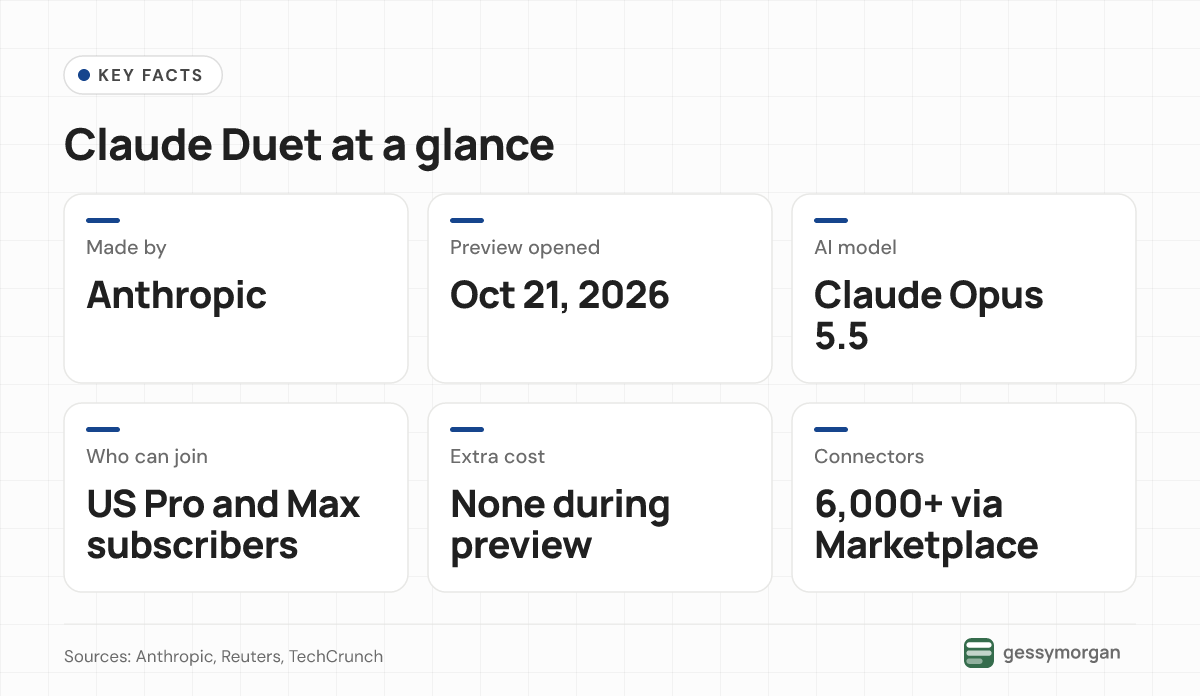
- Claude Duet is Anthropic's new proactive AI agent app, opened as a research preview on October 21, 2026, and built on Claude Opus 5.5.
- It is waitlist-only for US Claude Pro and Max subscribers, with no extra charge during the preview, but it shares those plans' usage limits.
- It asks before sending, paying, signing or deleting, never sees your passwords, and blocks trading or moving money even with approval.
Claude Duet is a new app from Anthropic in which its Claude AI works as a proactive agent. It sends you a morning brief, watches your connected work apps, keeps working on tasks in the background and asks before it acts for you. Anthropic opened it as a waitlist-only research preview on October 21, 2026, for Claude Pro and Max subscribers in the US, at no extra charge beyond those plans.
The launch, and the race between Anthropic, Meta and OpenAI to put always-on agents on people's phones, is why "Claude Duet" is trending in US tech searches. Below is what the app does, who can use it, what it costs and what to know about privacy, as of October 26, 2026.
What is Claude Duet?
Most chatbots wait for you to type. Duet is designed to come to you. In its launch post, Anthropic says the agent flags what needs your attention, completes jobs you hand it, keeps going when you step away and checks with you before acting on your behalf. The target audience is professionals and small business owners with more to track than time to track it.
Duet runs on Claude Opus 5.5, and during the preview you cannot switch to another model; Anthropic says the agent decides how much effort each job needs. The company pitches judgment as the main selling point. "What makes Claude Duet so helpful is its judgment," the launch post says.
Independent coverage matches that description. Reuters, via Investing.com, calls it a standalone AI agent app for professionals and small-business owners, and TechCrunch describes it as Anthropic's bet on agents, built on Opus 5.5.
What Claude Duet does
Duet works through the apps you connect to your Claude account. Anthropic's getting-started guide says it carries over your existing memory, skills and connectors, so it has context from your first message. The main features are:
- A morning brief. Each day it scans your email and calendar, ranks priorities and may start early steps, such as drafting replies for you to review.
- Regular check-ins. It looks at connected accounts every few hours rather than constantly, and messages you when something needs a decision.
- Background work. It runs on its own computer in the cloud, with its own browser, so tasks continue after you close the app or switch off your phone.
- One conversation. You type or send voice notes in a single main thread, and can add topic channels that share the same memory.
- Bigger projects. Anthropic lists scheduling, dashboards, financial or sales forecasts, prototypes and web apps. Finished work arrives as editable files in a Make tab, and ongoing jobs sit in a Tasks tab.
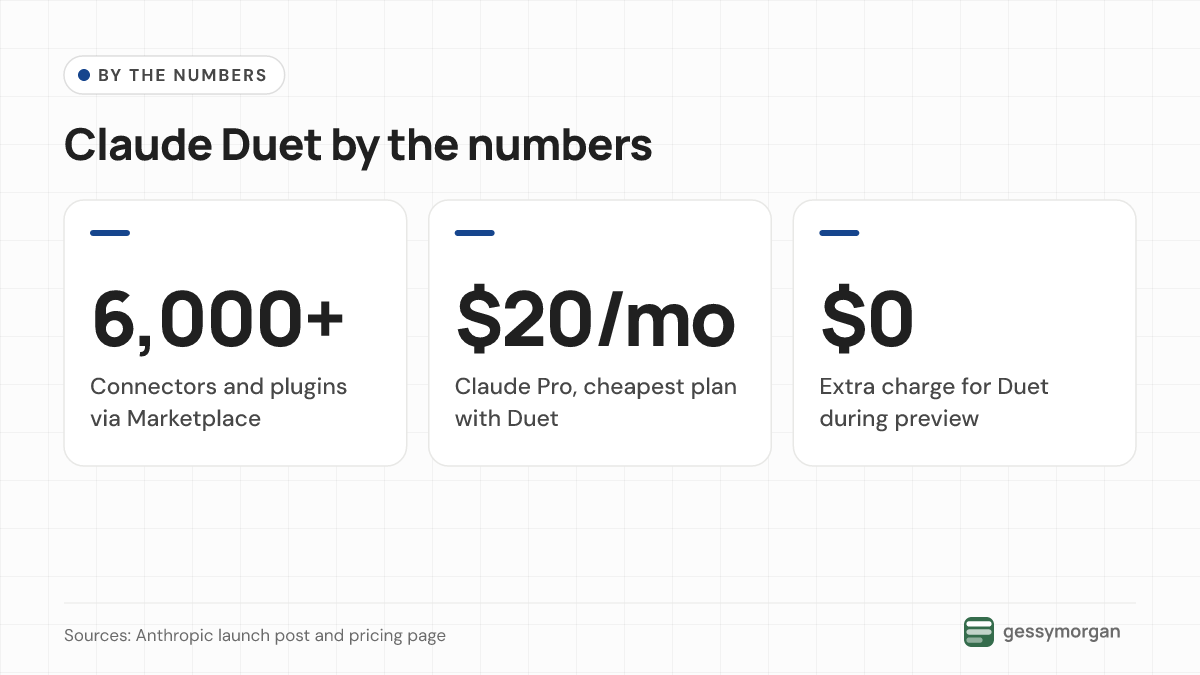
Anthropic says more than 6,000 connectors and plugins are available through the Claude Marketplace, with examples including Gmail, Slack, QuickBooks, Stripe, Gusto, Docusign, HubSpot, Canva and Shopify. Duet can also buy things through Stripe's Link wallet or Shopify's Shop Pay, using a one-time card for each purchase you approve. Anthropic's Shop Pay guide says Claude is not given your full card or bank account number.
Who can get it, and what it costs
As of October 26, 2026, access is limited. You need a Claude Pro or Max plan, a US-based Claude account and an invitation from the waitlist. Team and Enterprise plans are not supported yet, though Anthropic says they are planned. Invitations go out in waves, and the support guide warns, "Access is tied to the email address you gave us," so join with the email on your Claude account.
There is no separate price during the preview. Duet is included in Pro and Max and draws on the same five-hour and weekly usage limits as regular Claude chats. Background work, such as the morning brief and check-ins, counts too, so heavy users may hit limits sooner. People admitted from the waitlist get one full reset of both limits, usable until November 30, 2026.
For reference, Anthropic's pricing page lists Pro at $20 a month, or about $17 a month billed annually, and Max from $100 a month. Prices exclude tax and can change.
Duet is a phone app for iPhone and Android, and Anthropic says it is also available on claude.ai. For now it is separate from the main Claude app.
What it can't do yet
Anthropic is unusually direct about the preview's limits. The launch post admits Duet "still might misread a thread or miscalibrate what's urgent." Other gaps listed in Anthropic's documentation include:
- You cannot watch or take over its browser.
- Urgent items can arrive between scheduled check-ins.
- It cannot see your local files, and it can read but not edit your other Claude work.
- It does not place calls or text other people, though it can send email from connected accounts with your approval.
- Microsoft 365 is not available yet, and some connectors, such as Slack, have limits.
- Personal errands like booking tickets are weaker than work tasks, as TechCrunch also notes.
Privacy and safety notes
Because Duet can read email, calendars and business tools, its safeguards matter. Anthropic's safety, privacy and security post sets out the main ones:
- Approvals. Duet shows a preview and waits for approval before sending messages, paying, signing or deleting. A separate automated check, running outside the main model, compares each action with what you asked for.
- Hard limits. Trading securities, moving money between accounts and accessing someone else's account are blocked even if you approve.
- Credentials. Anthropic says Duet "never sees your passwords, browser cookies, or the sign-in tokens for your connected apps." Passwords go through an encrypted form, and a proxy outside the agent's machine inserts sign-in tokens.
- Sensitive data. A dedicated classifier stops Duet from sharing credentials, full card and bank numbers or government ID numbers. Health and financial details go out only with your explicit consent.
There are caveats. Anthropic concedes the classifier will sometimes miss something or flag a harmless message, and that no defense against hidden instructions on web pages is perfect. Duet keeps conversation history and memory until you delete it or reset memory. Disconnecting an app stops new access but does not erase what Duet already learned from it. Deleting your account removes everything.
Help Net Security highlights a practical warning from Anthropic: a genuine Duet password form only appears during a sign-in you start in the Claude app or on claude.ai, so a request arriving by email, text or another website is a phishing attempt. CBS News also notes security professionals' general advice to limit how much data you hand to any AI agent.
The safety post does not say whether Duet conversations are used to train models. Review your Claude privacy settings and Anthropic's privacy policy before connecting sensitive accounts.
How Claude Duet compares with Muse and Dots
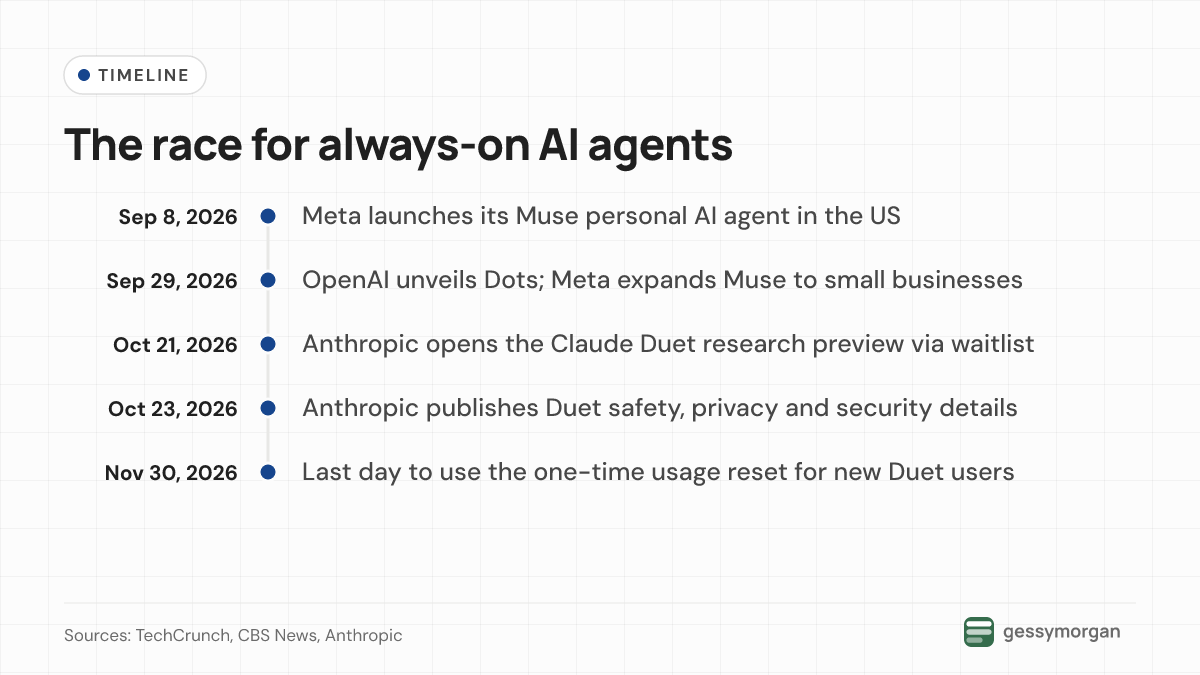
Duet arrives third in a fast-moving category. Meta launched its Muse personal agent in the US on September 8, 2026. TechCrunch reported that Muse is free to start, with paid Power and Maximum plans at $20 and $100 a month, and that it asks for a payment card even on the free tier. Meta then expanded Muse to small businesses on September 29, adding connectors such as Shopify, Slack, QuickBooks and Stripe.
OpenAI unveiled Dots, its always-on agents, at its DevDay event the same day. CBS News reports that Dots run on OpenAI's GPT-6 Astra model and are limited to ChatGPT Pro and Business Premium subscribers, with Pro starting at $100 a month.
On paper, the main differences are:
- Entry cost: Duet needs Claude Pro ($20 a month) or Max. Muse has a free tier. Dots start with a ChatGPT Pro plan from $100 a month, according to CBS.
- Focus: Duet and Dots lean toward work tasks. Muse began as a consumer agent and added a small-business version.
- Reach: Duet and Muse launched in the US only. Dots are offered in what OpenAI calls eligible markets.
- Maturity: Duet is explicitly a waitlisted research preview, with features that may change.
Digital Trends frames Duet as Anthropic's answer to Muse and Dots, TechCrunch also lists rivals such as Hark, Instinct, Grok Bot and Fo, and Android Authority pitches it as a challenger to Google's Gemini Intelligence on Android.
Our take
Based on Anthropic's documentation and the coverage so far, Duet's pitch is less about new skills and more about initiative: an agent that decides what deserves your attention. That is also the riskiest part, and Anthropic's own admission that Duet can misjudge urgency is worth taking at face value during a preview.
Pricing is its strongest card. Bundling Duet into a $20 Pro plan undercuts the $100 entry point for Dots, although shared usage limits mean heavy background work could push people toward Max. The approval cards, hard limits on moving money and credential isolation are sensible defaults for an agent with inbox access. Small business owners would still be wise to start with low-stakes connectors and read every approval request closely.
Anthropic is not the only company building guardrails for agents. Nvidia is pitching hardware-level controls too, as covered in our explainer on Nvidia's AI software licensing fee.
What to watch next
- When Duet opens to Team and Enterprise plans, which Anthropic says is planned.
- Any expansion beyond the US.
- Whether Duet gets its own price once the research preview ends.
- Sign-in with logins saved in 1Password, which Anthropic says is coming.
- More detail from Anthropic on data handling, including retention and training.
Frequently asked questions
Is Claude Duet free?
Not on its own. As of October 26, 2026, Duet is included at no extra cost for US subscribers on Claude Pro, listed at $20 a month, or Max, from $100 a month. It draws on the same usage limits as regular Claude chats, including background work like the morning brief.
How do I get access to Claude Duet?
Join the waitlist on Anthropic's Claude Duet product page using the email address on your Claude account, then wait for an invitation, which goes out in waves. You need a Pro or Max plan and a US-based account. Once invited, install the app on your iPhone or Android phone and sign in with your Claude account.
Is Claude Duet available outside the US?
Not yet. As of October 26, 2026, the research preview is limited to US-based Claude Pro and Max subscribers. Team and Enterprise plans are also excluded for now, though Anthropic says support for them is planned.
Is it safe to connect Claude Duet to my email?
Anthropic says Duet asks for approval before sending messages, paying, signing or deleting, never sees your passwords or sign-in tokens, and blocks sharing of card numbers and government IDs. It also admits its checks are not perfect during the preview. Consider starting with fewer connected apps and review Anthropic's privacy settings and policy.
How is Claude Duet different from the regular Claude app?
The regular Claude app answers when you ask. Duet runs on its own cloud computer, checks your connected apps every few hours, sends a daily brief and keeps working after you close it. During the preview it is a separate app from the main Claude app.
Sources
- Introducing Claude Duet, Anthropic
- Claude Duet Safety, Privacy, and Security, Anthropic
- Get started with Claude Duet, Anthropic (Claude Help Center)
- How to use Shop Pay with Claude Duet, Anthropic (Claude Help Center)
- Claude pricing, Anthropic
- Claude Duet app is Anthropic's bet on agents, TechCrunch
- Anthropic unveils Claude Duet AI agent app, Reuters via Investing.com
- Anthropic debuts Claude Duet personal AI agent. Here's what to know., CBS News
- Claude Duet is the new Android rival to Gemini Intelligence, Android Authority
- Anthropic unveils Claude Duet, its answer to AI agents like Dots, Digital Trends
- Anthropic details what stops Claude Duet from going rogue, Help Net Security
- Meta debuts its Muse AI agent. Will consumers trust it?, TechCrunch
- Meta is expanding its AI agent Muse to small businesses, TechCrunch
- Sam Altman unveils "dots," OpenAI's new AI personal agent, CBS News
How we wrote this
GessyMorgan explainers are built from public reporting and official sources. This post draws on the 14 sources listed above, each linked where we use it. It was drafted with AI assistance and checked against those sources before publishing. We did not test products, attend events or interview anyone for this article. Facts are current as of October 26, 2026, and we update the post when they change.