Outback Gold Nugget Find: The 1.2kg 'Tibooburra Spud' Explained
An anonymous Broken Hill prospector has unearthed a 1,218-gram nugget near Tibooburra in outback NSW. Here is what it may be worth, how it ranks against famous finds and the state's fossicking rules.
- An amateur Broken Hill prospector, who has not been named, found a 1,218-gram nugget containing about 940 grams of gold on Mount Stuart station near Tibooburra, NSW, in mid-October 2026.
- The ABC values it at A$150,000 to A$160,000 on the spot price (about US$105,500 to US$112,500 at the RBA rate on October 26), and the finder hopes a collector may pay up to A$200,000.
- It is tiny next to the 1869 Welcome Stranger, and NSW fossickers need landholder consent and must follow equipment and 48-hour take limits.
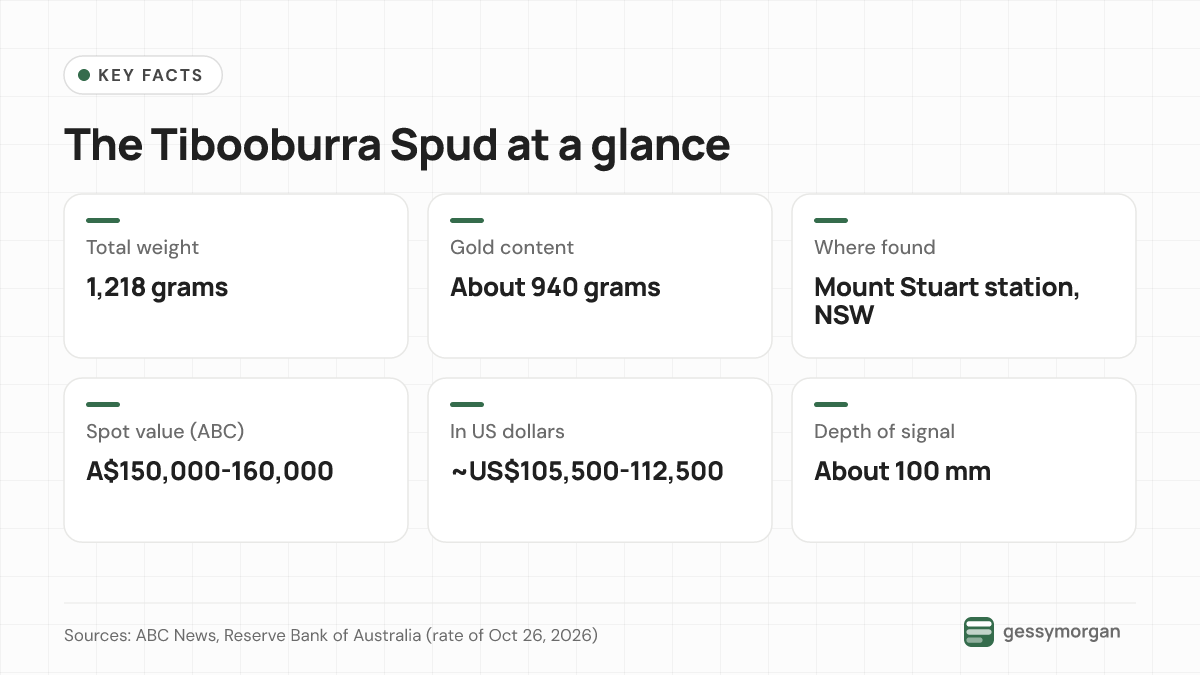
An amateur prospector from Broken Hill has found a gold nugget weighing 1,218 grams on Mount Stuart station near Tibooburra, in the far north-west of New South Wales (NSW), ABC News reported on October 26, 2026. Testing suggests it contains about 940 grams of gold, and at the spot price it is worth an estimated A$150,000 to A$160,000, or roughly US$105,500 to US$112,500. The finder, who has asked not to be named, calls it the "Tibooburra Spud."
Below is what has been reported about the find, what it might be worth, how it compares with Australia's most famous nuggets, and the rules for anyone tempted to try fossicking in NSW. All facts are as of October 26, 2026.
What was found, and where
According to the ABC, the prospector had spent several days detecting on Mount Stuart station and was finishing up for the day in mid-October when his metal detector, a Gold Monster 2000, picked up a faint signal. He told the ABC the signal was weak for an object that size, but became much louder once he had dug down about 100 millimetres.
"I just seen this bright yellow dot in the centre of the hole," he told the ABC. The nugget is flecked with quartz and spans about 8 to 9 centimetres against a ruler in the ABC's photos.
You may see the find described as both "nearly a kilo" and "more than a kilo" of gold, including on the ABC's video report. Both fit the reported numbers: the nugget weighs 1,218 grams in total, while the gold inside is estimated at about 940 grams.
Tibooburra is a small outback town about 335 kilometres north of Broken Hill and close to Sturt National Park, according to its Wikipedia entry. The ABC has not named the finder, and this article does not speculate about his identity.
How much is the Tibooburra Spud worth?
The ABC says the nugget is "said to be worth about $150,000," and that on the spot price it is worth between $150,000 and $160,000. The figures are in Australian dollars: the ABC puts the current gold price at about $5,700 per troy ounce, which matches the Perth Mint's posted Australian-dollar price, about A$5,693 to A$5,743, at 8:26 pm AWST on October 26 (12:26 UTC). The same table showed about US$4,005 to US$4,033.
The finder plans to sell to a collector and believes the price could reach as much as A$200,000. Converted at the Reserve Bank of Australia's rate for October 26, 2026 (US$0.7031 per Australian dollar):
- A$150,000 is about US$105,500
- A$160,000 is about US$112,500
- A$200,000 is about US$140,600
Treat every figure as an estimate. By our own arithmetic, 940 grams is about 30.2 troy ounces, which at A$5,700 an ounce comes to roughly A$172,000, above the ABC's range. The ABC did not explain how its range was calculated, and the gold content is itself an approximate test result. The final price will depend on the buyer.
How it compares with famous Australian nuggets
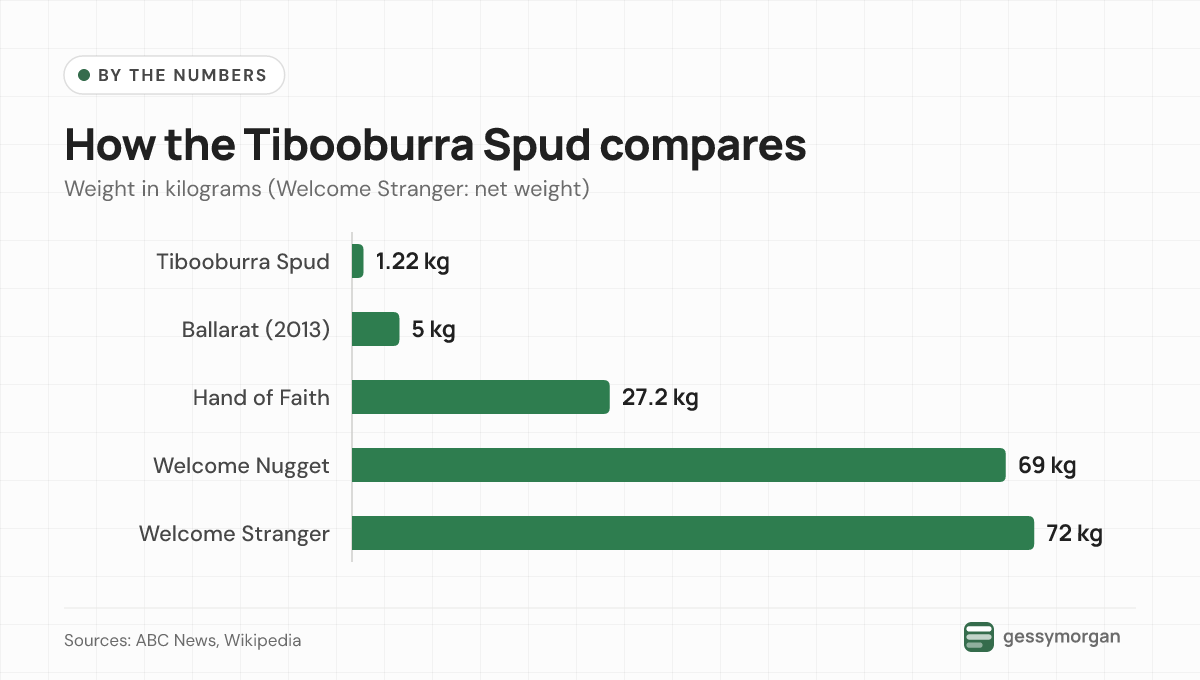
A kilo-class nugget is rare for a hobbyist, but it is small next to the giants of Australian gold history:
- Welcome Stranger (1869): found by John Deason and Richard Oates at Moliagul, Victoria, and widely regarded as the largest gold nugget ever found. The Welcome Stranger entry gives a net weight of about 72 kilograms, while a separate list of large nuggets puts it nearer 71 kilograms. Either way, that is more than 75 times the gold estimated in the Tibooburra Spud.
- Welcome Nugget (1858): found at Ballarat, Victoria, weighing about 69 kilograms.
- Hand of Faith (1980): found by Kevin Hillier near Kingower, Victoria, weighing about 27.2 kilograms (875 troy ounces). The Hand of Faith entry describes it as the largest nugget found with a metal detector. It sold for more than US$1 million and is displayed in Las Vegas.
- Ballarat find (2013): an amateur prospector found a nugget of just over 5 kilograms, valued at just under A$300,000 at the time.
NSW has its own record-breaker. The Holtermann specimen, found at Hill End near Bathurst in 1872, held an estimated 93 kilograms of gold. As its Wikipedia entry notes, it was gold embedded in quartz from a reef rather than a true alluvial nugget.
Closer to home, Broken Hill prospecting supplier Greg Spangler told the ABC he has seen only one other find of more than a kilogram in about 20 years of selling gear. Most finds are flakes or small nuggets weighing a few ounces.
Tibooburra's gold history
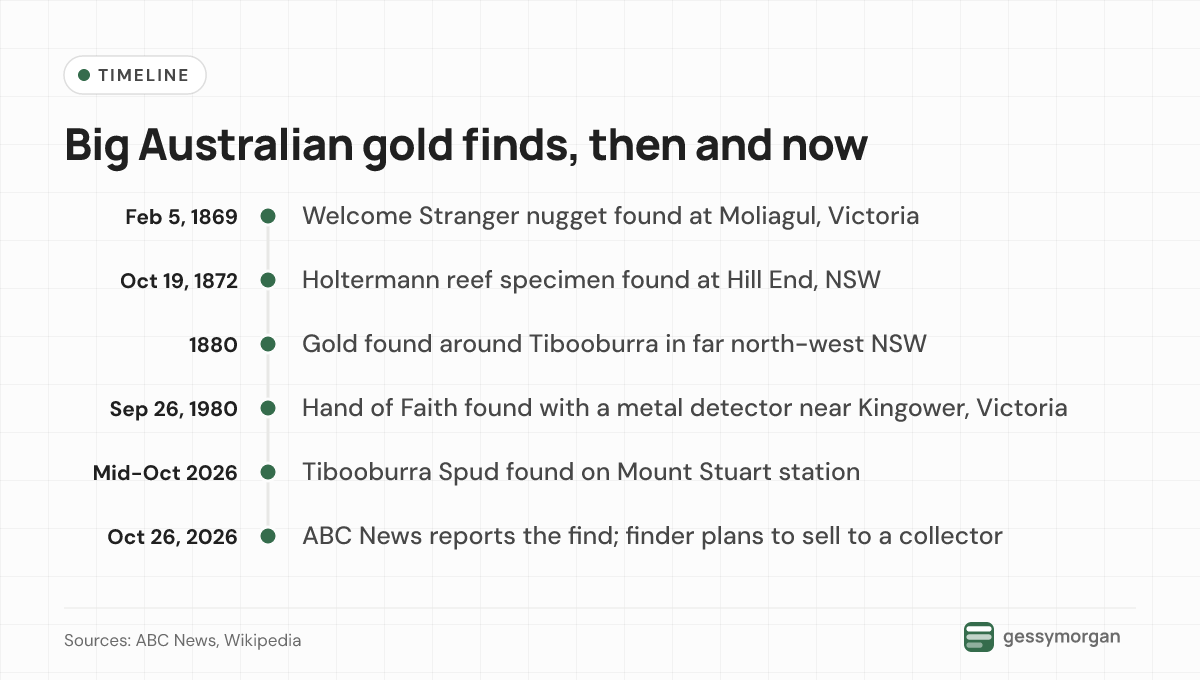
Gold was found around Tibooburra in 1880, after a rush to the Albert Goldfields centred on nearby Milparinka. The town was laid out in 1881, and by 1887 the local goldfields warden recorded 19 puddling machines at work. Mining had faded by 1900 and pastoral stations took over. The ABC says prospecting there dates to the 1880s and still draws many visitors.
Spangler told the ABC that high gold prices are drawing new people to the hobby, and that fresh rain often exposes gold in places others have already searched.
The rules for prospecting in New South Wales
In NSW, recreational prospecting is called fossicking. The NSW Resources fossicking page says it is lawful, but the Mining Act 1992 and Mining Regulation 2016 set conditions. The main ones, from the state's official fossicking guide (2025 edition), are below. This is general information, not legal advice; check the official guide before you go.
Permission comes first
- Private land: you need the landholder's consent and must follow their conditions, such as which tracks and gates to use.
- Mining titles and claims: you need the holder's consent, except on exploration licences inside a designated Fossicking District.
- Crown land and state forests: some Crown land carries a right of entry, while other areas need authorisation. Fossicking is allowed in many state forests with a 12-month permit from the Forestry Corporation.
- Native title land: fossicking needs the consent of the registered native title body corporate.
- National parks: fossicking is generally not permitted, according to the NSW parks fossicking policy, unless a park's plan of management allows it.
Locally, the ABC reports that fossicking on the Tibooburra Common is currently banned while Native Title permissions are pursued, but at least two stations, Mount Stuart and Gumvale, allow fossicking for a fee.
Equipment and limits
- Hand tools such as picks, shovels, pans and sieves, plus metal detectors and non-powered sluices, are permitted. Explosives and powered digging or processing equipment are banned.
- No more than one cubic metre of material may be disturbed in any 48-hour period, and holes must be refilled to restore the soil profile.
- Each person may take up to five gold nuggets of 10 grams or more, plus up to 50 grams of smaller gold, in any 48-hour period.
- Publicly owned gold found during lawful fossicking belongs to the finder, and no royalties are payable.
Breaches can bring fines of A$750 for an individual and A$1,500 for a company, with a maximum court-imposed penalty of A$5,500. Other Australian states run their own systems, so check the relevant state government before prospecting elsewhere.
Our take
Going by the sources, this is a genuinely rare find for a hobbyist, and it lands while gold prices are high, though below January's peak of almost A$8,000 an ounce that the ABC cites. That combination explains why the story has travelled well beyond Broken Hill.
It is also a reminder that the headline value is an estimate until the nugget sells, and that the hobby is tightly regulated. What to watch next: whether the nugget is sold to a collector and at what price, and whether fossicking reopens on the Tibooburra Common once the Native Title process is resolved.
Frequently asked questions
Who found the Tibooburra gold nugget?
The ABC describes the finder only as an amateur prospector from Broken Hill who has been fossicking for years. He asked not to be named, and his identity has not been made public.
How much is the Tibooburra Spud worth?
The ABC reports it is worth about A$150,000 to A$160,000 on the spot price, roughly US$105,500 to US$112,500 at the RBA rate of October 26, 2026. The finder hopes a collector might pay up to A$200,000. Any figure is an estimate until it sells.
What is the biggest gold nugget ever found in Australia?
The Welcome Stranger, found at Moliagul, Victoria, in 1869 by John Deason and Richard Oates, is widely regarded as the largest gold nugget ever found. Sources give its net weight at about 71 to 72 kilograms.
Do you need permission to fossick for gold in NSW?
Yes. The NSW fossicking guide says you need the landholder's consent on private land, and consent from mining title holders, native title bodies or land managers in other cases. National parks are generally off limits. Check the NSW Resources guide for the full rules.
Can you keep the gold you find in NSW?
According to the NSW guide, publicly owned gold recovered during lawful fossicking becomes the finder's property, and no royalties are payable. Limits apply, including five nuggets of 10 grams or more per person in any 48-hour period.
Sources
- Amateur prospector discovers gold nugget worth $150,000 on outback station, ABC News
- Nearly a kilo of gold was found on a station in Tibooburra (video), ABC News
- Exchange Rates, Reserve Bank of Australia
- Metal prices, The Perth Mint
- Fossicking in NSW, NSW Resources
- Fossicking: A guide to fossicking in NSW (2025), NSW Resources Regulator
- Fossicking policy, NSW Environment and Heritage
- Welcome Stranger, Wikipedia
- Gold nugget, Wikipedia
- Hand of Faith, Wikipedia
- Holtermann Nugget, Wikipedia
- Tibooburra, Wikipedia
How we wrote this
GessyMorgan explainers are built from public reporting and official sources. This post draws on the 12 sources listed above, each linked where we use it. It was drafted with AI assistance and checked against those sources before publishing. We did not test products, attend events or interview anyone for this article. Facts are current as of October 26, 2026, and we update the post when they change.