Election Night 2026: Poll Closing Times and When Results Come In
Polls start closing at 6 p.m. ET on Tuesday, Nov. 3, and the last close at 1 a.m. ET in Alaska. Here is when results usually arrive, the races to watch, how the AP calls winners and where official numbers appear.
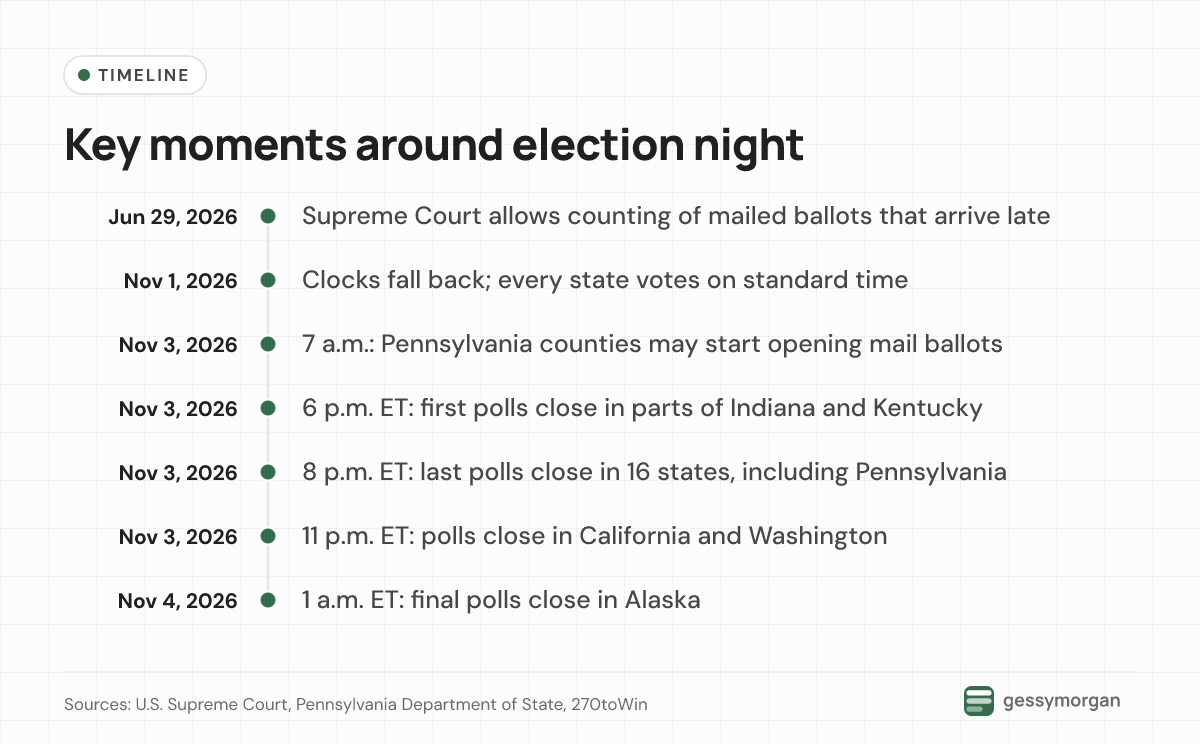
- Election night is Tuesday, Nov. 3, 2026: polls start closing at 6 p.m. ET and the last close at 1 a.m. ET on Nov. 4 in Alaska.
- Results appear as polls close but stay unofficial; mail-ballot rules and close margins can delay calls by days, as in 2022.
- The AP calls a race only when trailing candidates cannot catch up, and declares control of Congress only at 218 House or 51 Senate seats.
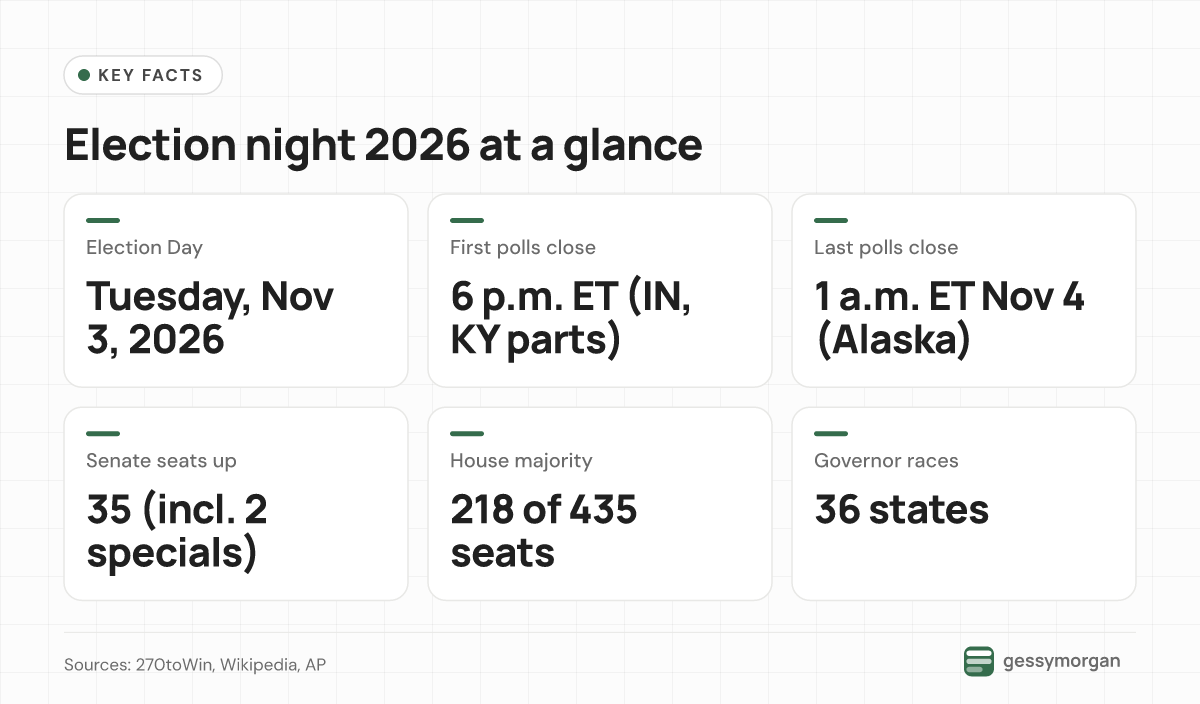
Election night 2026 is Tuesday, November 3. The first polls close at 6 p.m. ET (3 p.m. PT) in the Eastern Time parts of Indiana and Kentucky, and the last close at 1 a.m. ET on Wednesday, November 4 (10 p.m. PT Tuesday) in Alaska's far western islands. Results appear as each state's polls close, but close races, including the contest for control of Congress, can take days to settle.
This guide covers the night itself. For what is on the ballot and how to vote, see our Election Day 2026 midterms guide. Everything here is current as of October 26, 2026.
Poll closing times by state (Eastern Time)
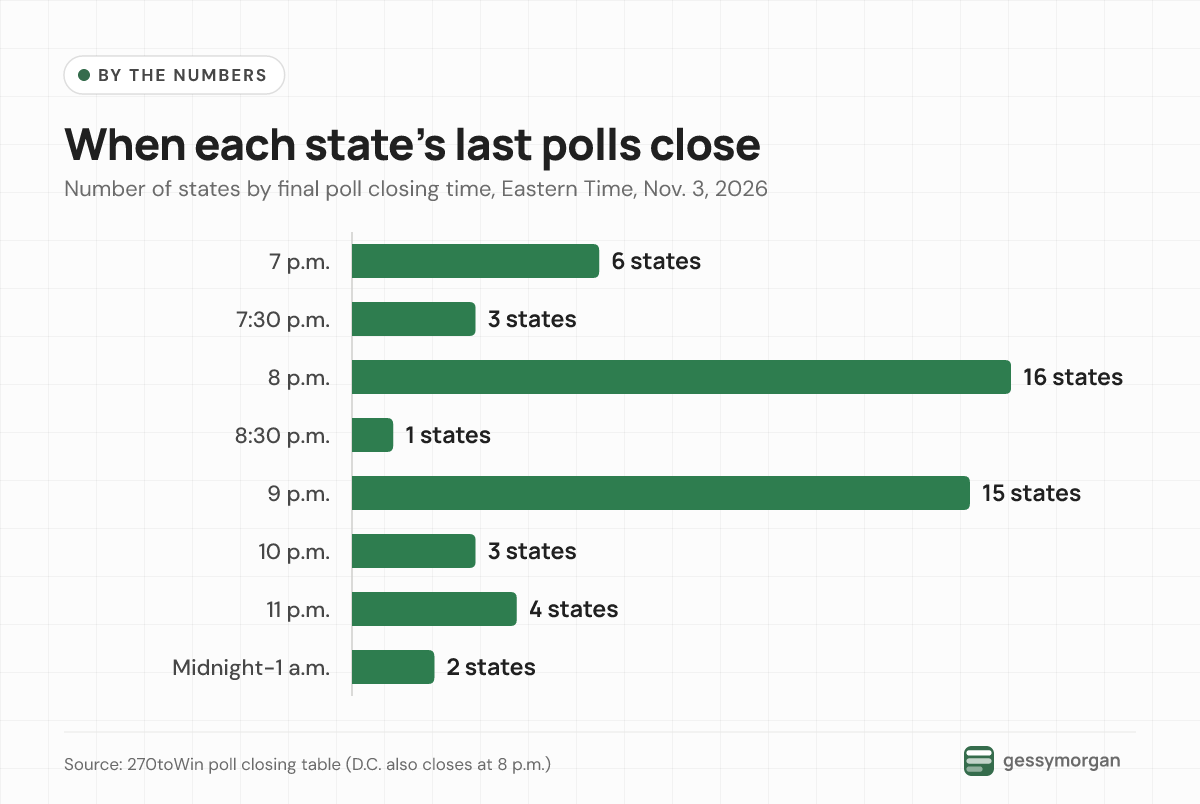
Daylight saving time ends on November 1, so every state votes on standard time. The list below shows when the last polls close in each state, based on 270toWin's 2026 poll closing table. States that span two time zones appear twice, and 270toWin notes that many New Hampshire polling places close an hour before the statewide time.
- 6 p.m.: Eastern Time parts of Indiana and Kentucky
- 7 p.m.: Georgia, South Carolina, Vermont, Virginia, the rest of Indiana and Kentucky, and most of Florida
- 7:30 p.m.: North Carolina, Ohio, West Virginia
- 8 p.m.: Alabama, Connecticut, Delaware, Illinois, Maine, Maryland, Massachusetts, Mississippi, Missouri, New Hampshire, New Jersey, Oklahoma, Pennsylvania, Rhode Island, Tennessee, Washington, D.C., the Florida Panhandle, and most of Kansas, Michigan, North Dakota, South Dakota and Texas
- 8:30 p.m.: Arkansas
- 9 p.m.: Arizona, Colorado, Iowa, Louisiana, Minnesota, Nebraska, New Mexico, New York, Wisconsin, Wyoming, and the remaining parts of Kansas, Michigan, North Dakota, South Dakota and Texas
- 10 p.m.: Montana, Nevada, Utah, and parts of Idaho and Oregon
- 11 p.m.: California, Washington, and the rest of Idaho and Oregon
- Midnight: Hawaii and most of Alaska
- 1 a.m. Wednesday: Alaska's Hawaii-Aleutian time zone
California's Secretary of State lists polling hours of 7 a.m. to 8 p.m. local time (11 p.m. ET), and Pennsylvania's Department of State lists 7 a.m. to 8 p.m. Voters already in line at closing time can generally still vote, as The Open Count points out.
When results usually come in
The AP starts reporting as soon as results are available, which can be as early as a state's first legal closing time, according to its vote-count explainer. Every number you see that night is unofficial. Protect Democracy puts it plainly: "Election night numbers are unofficial and will change."
Leads can shift because early, mail and Election Day ballots are often counted at different times, and each party's voters may favor different methods. As Protect Democracy notes, "Those shifts come from the order of the count." State rules decide much of the timing:
- Pennsylvania: State law bars counties from opening mail ballots until 7 a.m. on Election Day, and those ballots must arrive by 8 p.m. The Department of State's FAQ says statewide results start appearing after 8 p.m.
- Georgia: By 8 p.m. on Election Day, counties must now report results for early in-person votes and for verified mail ballots received by 8 p.m. the day before, a new requirement noted by Voting Rights Lab.
- Michigan: A 2023 law lets communities with at least 5,000 residents start processing mail ballots before Election Day.
- North Carolina: An August 2026 law requires counties to begin tabulating early and mail votes during Election Day instead of waiting for polls to close. Mail ballots arriving after Election Day no longer count there.
- Ohio: A 2025 law ended the grace period for mail ballots arriving after Election Day.
- California: Mailed ballots count if postmarked on or before November 3, so some arrive after Election Day. Protect Democracy lists California among states with longer counting timelines.
The Supreme Court addressed late-arriving ballots this year. In Watson v. Republican National Committee, decided June 29, 2026, the Court let Mississippi count absentee ballots mailed by Election Day that arrive up to five days later. Its published summary states that "nothing in the federal election-day statutes requires ballots to be received by election day."
History suggests patience. In 2022, control of the House was not clear until November 16, eight days after Election Day, according to Wikipedia's account of that election. The AP called the 2020 presidential race four days after Election Day and the 2024 race at 5:34 a.m. ET the next morning.
Key races to watch
Republicans hold 53 Senate seats and Democrats 45, with two independents who caucus with Democrats. Thirty-five seats are up, including special elections in Florida and Ohio, and Democrats would need a net gain of four seats to win control, according to 270toWin. In the House, a majority takes 218 seats. Wikipedia lists 218 Republicans, 214 Democrats, one independent and two vacancies going into the vote.
The ratings below come from the Cook Political Report, Inside Elections and Sabato's Crystal Ball, as compiled by Wikipedia. Ratings describe how competitive a race looks, not who will win. Candidates are listed alphabetically.
Senate races rated toss-ups
Cook's October 20 ratings list seven Senate toss-ups, per Wikipedia's Senate ratings table. In order of each state's last poll closing:
- Ohio special (7:30 p.m.): Sherrod Brown (D) and Sen. Jon Husted (R), plus independent and Libertarian candidates
- Maine (8 p.m.): Sen. Susan Collins (R) and Troy Jackson (D)
- Iowa (9 p.m., open seat): Ashley Hinson (R) and Josh Turek (D)
- Kansas (9 p.m.): Adam Hamilton (D) and Sen. Roger Marshall (R)
- Michigan (9 p.m., open seat): Abdul El-Sayed (D) and Mike Rogers (R)
- Texas (9 p.m., open seat): Ken Paxton (R) and James Talarico (D)
- Alaska (1 a.m.): Mary Peltola (D) and Sen. Dan Sullivan (R), among others
At least one forecaster also rates races in Georgia (Mike Collins, R, and Sen. Jon Ossoff, D), Minnesota (Peggy Flanagan, DFL, and Michele Tafoya, R), Nebraska (independent Dan Osborn and Sen. Pete Ricketts, R), New Hampshire (Chris Pappas, D, and John E. Sununu, R) and North Carolina (Roy Cooper, D, and Michael Whatley, R) as competitive.
Governor races
Thirty-six states elect governors, and each party is defending 18 of those seats, according to Wikipedia's governor ratings page. Cook's October 23 ratings list three toss-ups: Georgia (Keisha Lance Bottoms, D, and Rick Jackson, R), Nevada (Aaron Ford, D, and Gov. Joe Lombardo, R) and Wisconsin (David Crowley, D, and Tom Tiffany, R). 270toWin lists the same nominees. Forecasters also see competitive races in Alaska, Arizona, Iowa, Kansas, Michigan and Ohio, where Amy Acton (D) faces Vivek Ramaswamy (R); see our Ohio governor race explainer.
House battleground
Toss-up counts differ by forecaster: 17 House races for Cook (October 23), 18 for Inside Elections (October 15) and 12 for Sabato's Crystal Ball (October 20), per Wikipedia's House ratings page. Cook's toss-ups include seats in California, Michigan, New York, Ohio, Pennsylvania, Texas and Virginia. Texas, California, North Carolina, Ohio, Utah and other states redrew maps mid-decade, so some districts differ from 2024.
How the AP calls races
Many news outlets report winners "according to The Associated Press." AP says it declares winners in about 5,000 contested races in a general election and that it "does not make projections or name apparent or likely winners." Its Decision Team calls a race only when the trailing candidates no longer have a path to victory, according to AP's explainer on declaring winners.
- The count: More than 4,000 AP vote count reporters collect results at county offices and precincts, and close to 1,000 clerks enter them, alongside official websites and data feeds. AP has counted the vote in every presidential election since 1848.
- Too early or too close: A race is "too early to call" while counting continues. AP may call it "too close to call" once tabulation is essentially finished and the margin is generally under 0.5 percentage points.
- Control of Congress: AP announces control only after calling 218 House seats or 51 Senate seats for one party (50 if the vice president belongs to that party). It does not use statistical models to predict control.
- Recounts: AP may call a race headed for a recount if the lead is too large to overturn. Since 2000, it says, at least 37 statewide recounts changed the outcome three times.
Where to find official results
State election offices post unofficial results on election night, and certification follows weeks later on schedules set by state law, The Open Count notes. Counties certify first and then the state. To find your state's election office, use the U.S. Election Assistance Commission's state directory. A few examples:
- Pennsylvania: statewide results on the Department of State's election returns site after 8 p.m., with local results on county board websites
- North Carolina: the State Board of Elections results portal, searchable by county and contest
- AP race calls: published on apnews.com and by outlets that use AP data
How to follow it
- Check a state's closing time before reading anything into its first numbers.
- Look for AP's expected-vote estimate of ballots left to count; AP says precincts reporting can mislead when early votes are reported as one precinct.
- Expect slower counts where late-arriving mail ballots are allowed and where margins are close enough for a recount.
Our take
Based on the sources above, a slow count is not a sign of trouble on its own. With five Senate toss-ups in states whose last polls close at 9 p.m. ET or later, the balance of power may not be known on election night. As Protect Democracy puts it, "A long count is evidence that safeguards are running, not that they failed."
Frequently asked questions
What time do polls close on election night 2026?
The first polls close at 6 p.m. ET on Tuesday, November 3, in the Eastern Time parts of Indiana and Kentucky. Most states finish by 9 p.m. ET, California and Washington close at 11 p.m. ET, and the last polls close in Alaska at 1 a.m. ET on November 4. Hours are set by each state, so check your state election office.
When will we know who controls Congress after the 2026 midterms?
It could be election night or several days later. The AP announces control only after it has called 218 House seats or 51 Senate seats for one party. In 2022, House control was not clear until November 16, eight days after Election Day.
How does the AP call a race?
AP's Decision Team studies its vote count, the type and location of ballots still outstanding and past voting patterns. It calls a race only when it is confident the trailing candidates cannot catch the leader, and it does not make projections.
Where can I see official 2026 election results?
Each state's election office posts results, and the U.S. Election Assistance Commission's state directory links to all of them. Election-night numbers are unofficial; counties and then states certify final results weeks later on schedules set by state law.
Why do election results change after election night?
Different kinds of ballots, such as early, mail and Election Day votes, are counted at different times. Officials also check provisional ballots, let voters fix problems such as missing signatures, and in some states count mail ballots that arrive after Election Day if they were postmarked in time.
Sources
- 2026 Election Poll Closing Times, 270toWin
- 2026 Senate Election Interactive Map, 270toWin
- 2026 Governor Election Interactive Map, 270toWin
- How we declare winners, The Associated Press
- How AP counts the vote, The Associated Press
- 2026 United States Senate elections, Wikipedia
- 2026 United States gubernatorial elections, Wikipedia
- 2026 United States House of Representatives elections, Wikipedia
- 2026 United States House of Representatives election ratings, Wikipedia
- 2022 United States House of Representatives elections, Wikipedia
- When polls close on Nov 3, and where each state posts its official results, The Open Count
- What to expect during the 2026 election season, Protect Democracy
- 2026 Battleground Report: How Voting Rules Have Changed Since the 2022 Midterms, Voting Rights Lab
- Opinions of the Court, 2025 term (Watson v. Republican National Committee), Supreme Court of the United States
- General Election, November 3, 2026, California Secretary of State
- Upcoming Elections, Pennsylvania Department of State
- Elections FAQs, Pennsylvania Department of State
- Register and Vote in Your State, U.S. Election Assistance Commission
- Contest Results, North Carolina State Board of Elections
How we wrote this
GessyMorgan explainers are built from public reporting and official sources. This post draws on the 19 sources listed above, each linked where we use it. It was drafted with AI assistance and checked against those sources before publishing. We did not test products, attend events or interview anyone for this article. Facts are current as of October 26, 2026, and we update the post when they change.