Ebola Outbreak 2026: Cases, Countries and What WHO Says
A Bundibugyo Ebola outbreak in DR Congo has passed 9,700 confirmed cases, with imported cases in Kenya and Nigeria. Here is what WHO, Africa CDC and the US CDC say as of October 26, 2026.
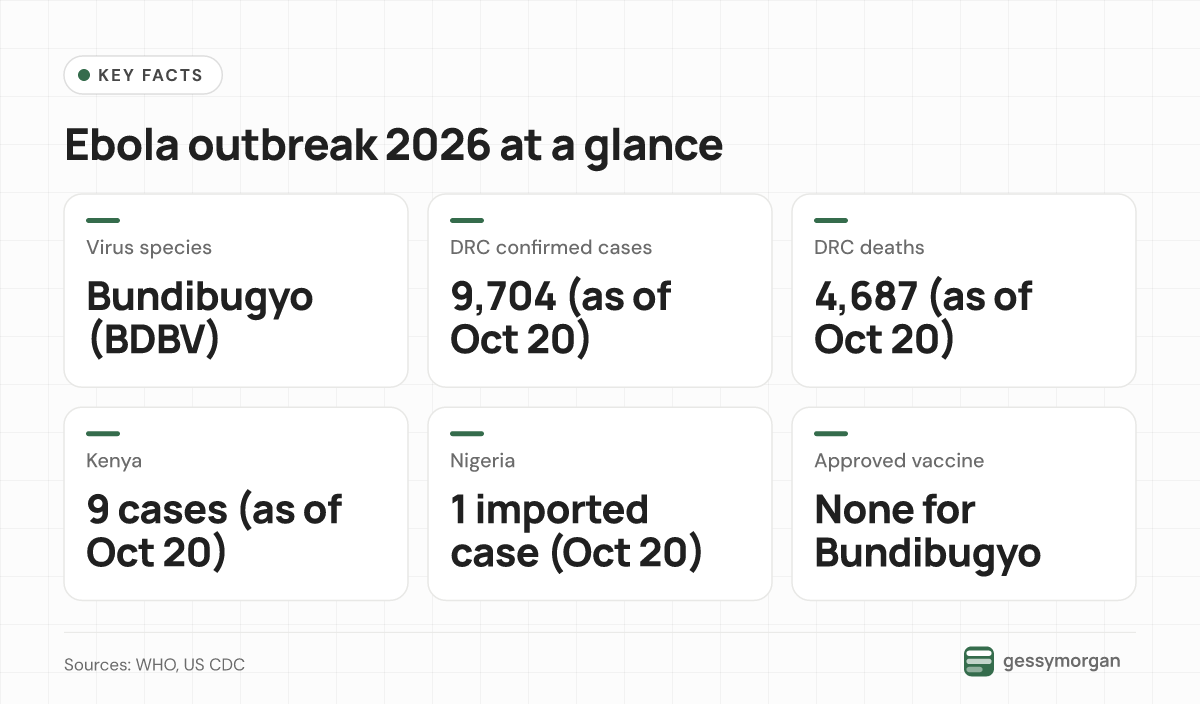
- The 2026 outbreak is caused by Bundibugyo virus and centred in eastern DR Congo, with 9,704 confirmed cases and 4,687 deaths as of October 20, per WHO.
- Kenya has 9 cases in one cluster and Nigeria confirmed 1 imported case in Abuja on October 20; that patient was flown to Switzerland on October 26.
- There is no approved vaccine or specific treatment for Bundibugyo; WHO and the US CDC rate the risk to the wider public as low.
As of October 26, 2026, the Ebola outbreak in the news is a Bundibugyo virus epidemic centred in the eastern Democratic Republic of the Congo (DRC). WHO counted 9,704 confirmed cases and 4,687 deaths there up to October 20. Imported cases in Kenya and Nigeria this month explain the spike in searches from Nigeria and the United States, but WHO, the US CDC and European health officials still rate the risk to the general public outside the affected region as low.
This explainer draws on WHO, Africa CDC, the US CDC and Nigerian health authorities. It is general public-health information, not medical advice. If you are worried about symptoms or a possible exposure, contact your national health authority or a doctor.
Where the outbreak is
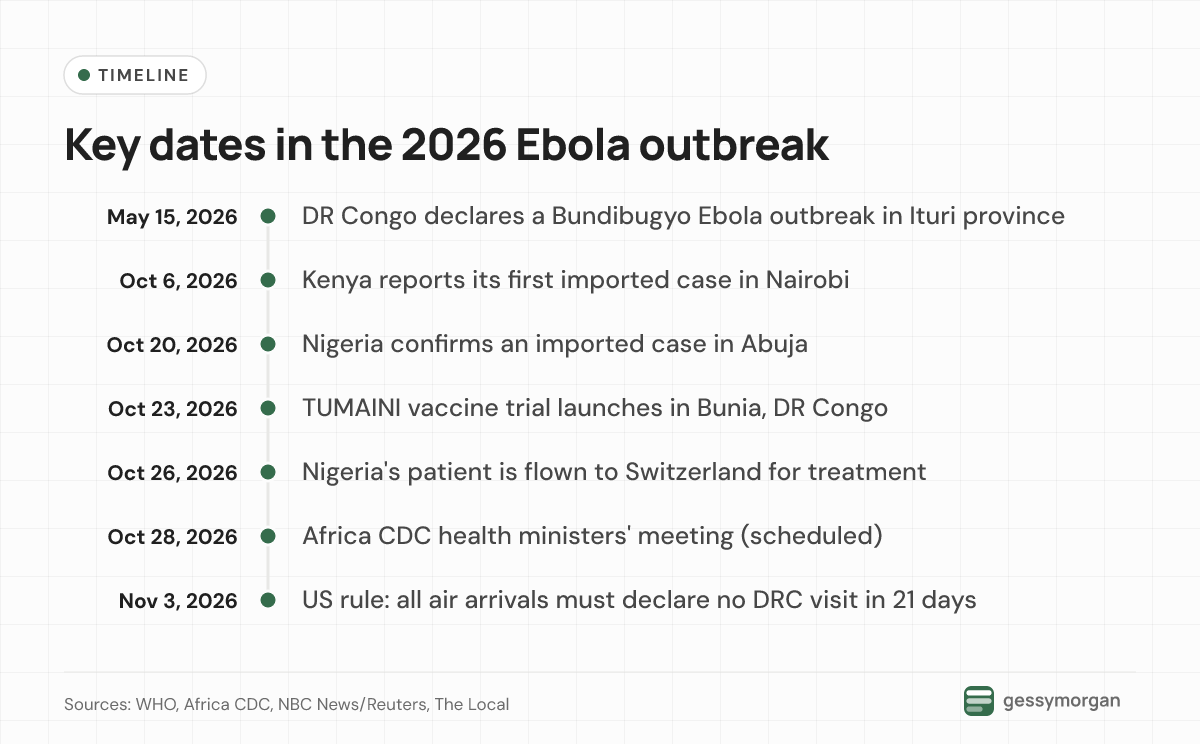
The DRC declared the outbreak on May 15, 2026, after cases were detected in Ituri province, according to WHO's latest Disease Outbreak News. It is the country's 17th Ebola outbreak and, in WHO's words, the largest ever recorded there.
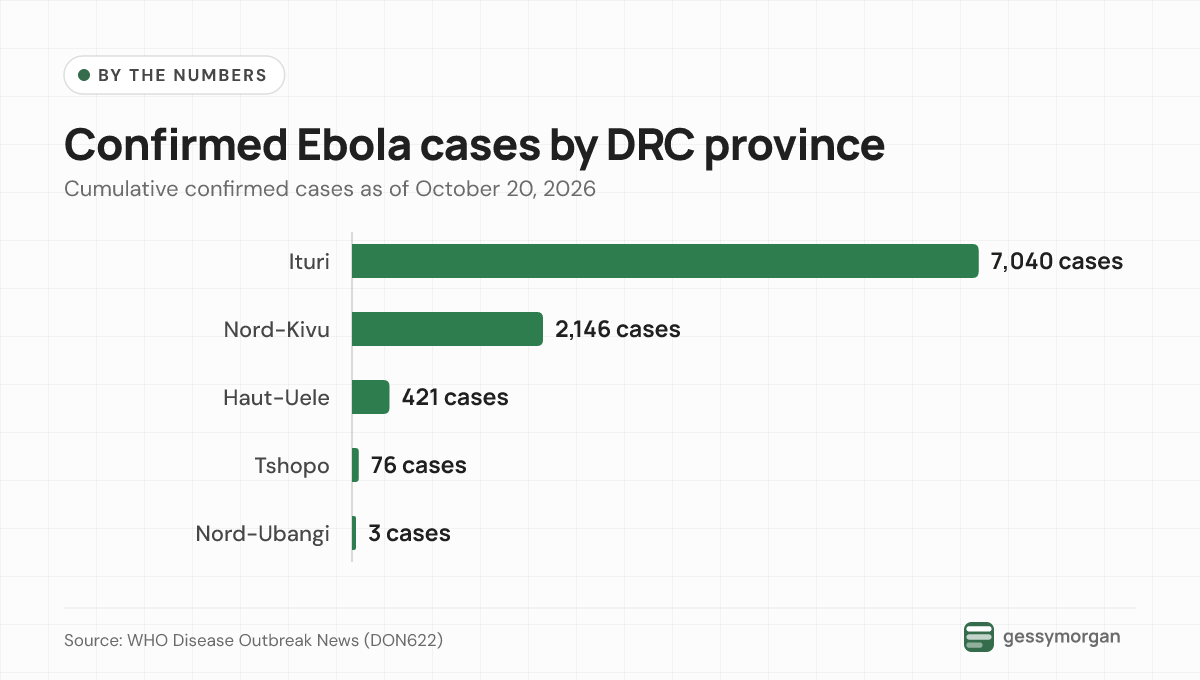
By October 20, confirmed cases had been found in 66 health zones across eight DRC provinces. Ituri remains the epicentre with 7,040 cases, followed by Nord-Kivu with 2,146. Nord-Kivu has the highest provincial death rate, at 55.9% of confirmed cases.
Outside the DRC, the CDC's October 24 situation summary lists confirmed cases in Uganda, Kenya, Nigeria and France. Uganda's outbreak of 20 confirmed cases has ended, and France's single patient, a doctor who had returned from the DRC, recovered in July. The European Centre for Disease Prevention and Control also records aid workers medically evacuated to Germany and the Netherlands.
Which Ebola virus is it?
The outbreak is caused by Bundibugyo virus (BDBV). The WHO Ebola fact sheet lists it as one of three orthoebolavirus species behind large outbreaks, alongside Ebola virus (the "Zaire" species) and Sudan virus. Before 2026, only two Bundibugyo outbreaks were known: Uganda in 2007 and the DRC in 2012.
The species matters. The vaccines and antibody treatments licensed after the 2014 to 2016 West Africa epidemic were built for Ebola virus, not Bundibugyo. WHO notes that earlier Bundibugyo outbreaks killed roughly 30% to 50% of people infected.
Latest case and death counts
Agencies publish on different days, so totals differ slightly:
- DRC (WHO, as of October 20): 9,704 confirmed cases, 4,687 deaths (a 48.3% case fatality rate) and 2,595 recoveries.
- DRC (national data, as of October 23): 9,876 confirmed cases and 4,803 deaths, as compiled by Outbreak News Today. The CDC's update gives 9,816 cases and 4,757 deaths for the same date.
- Kenya (as of October 20): 9 cases. WHO reports 1 death, while the CDC lists 2.
- Nigeria (as of October 20): 1 imported case and no deaths.
- Uganda: 20 confirmed cases and 2 deaths; the outbreak there is over.
WHO says many deaths still happen at home rather than in treatment centres: 307 of the 482 deaths reported between October 8 and October 20. Only 79.7% of DRC contacts were being followed up, short of WHO's 95% target.
The Kenya and Nigeria cases
Kenya
Kenya reported its first case on October 6. WHO says the man travelled overland from the DRC through Uganda, flew into Nairobi on October 3 and died on October 5. Eight more cases followed, four relatives and four health or care workers, all within one cluster. All 135 contacts were quarantined, and WHO says there is no evidence of spread beyond that group.
Nigeria
On October 20, Nigeria confirmed an imported case in Abuja, the Federal Capital Territory. According to WHO's Africa office, the woman arrived from Uganda around October 3, fell ill on October 7 and sought care at a private clinic on October 11. A laboratory confirmed Bundibugyo virus on October 20.
News reports describe her as a 42-year-old woman married to a Swiss diplomat based in Abuja. "The strain was Bundibugyo," the lab director of the Nigeria Centre for Disease Control and Prevention (NCDC), Olajumoke Babatunde, told Al Jazeera. How she was infected is still unclear. Swiss officials and Africa CDC say her travel documents show no visit to the DRC, contradicting Ugandan officials, Reuters reported. Scientists are examining a possible link with Kenya's first patient, who also passed through Entebbe airport on October 3.
Nigerian officials have now identified 53 contacts, up from 44, according to The Telegraph (Nigeria). Early on Monday, October 26 (Abuja time, UTC+1), the patient was flown to Switzerland for further care, with her husband, who has no symptoms. Health Minister Muhammad Ali Pate said she was "clinically much improved," according to Reuters, but warned that "This does not mean she is not still infectious," as The Local reported.
How the response is organised
- WHO declared the epidemic, then affecting the DRC and Uganda, a public health emergency of international concern in mid-May. Its formal risk assessment from August 14 rates the risk very high in the DRC, high in neighbouring countries and low globally, and WHO says it is being revised. WHO advises against restricting travel to or trade with affected countries.
- Africa CDC declared a Public Health Emergency of Continental Security, according to the Africa CDC Knowledge Hub. Its director-general, Jean Kaseya, told Semafor: "We do not recommend border closures." He warned that people would switch to informal crossings. Africa CDC has called a virtual meeting of African health ministers for October 28, Nigeria Info FM reported.
- Nigeria's NCDC has activated its incident management system. Contacts are monitored for 21 days after their last exposure. The NCDC posted its latest response update on October 25 on its press page and runs a toll-free line, 6232.
- Doctors Without Borders (MSF) says it runs eight treatment centres across five DRC provinces and supports Kenya's health ministry, according to its response page.
Vaccines and treatments
WHO says there is no approved vaccine or specific treatment for Bundibugyo virus disease. The licensed Ervebo vaccine and the antibody treatments ansuvimab and Inmazeb all target Ebola virus.
- TUMAINI trial: a Phase 2/3 trial of candidate Bundibugyo vaccines launched in Bunia, Ituri, on October 23 with WHO support.
- Ervebo study: MSF is studying whether Ervebo gives frontline workers extra protection. Semafor reports about 9,000 frontline workers have received it. Protection against Bundibugyo is not proven.
- PARTNERS trial: MSF says this trial is testing remdesivir and the antibody MBP134 in patients.
For now, care depends on early supportive treatment such as fluids, oxygen and symptom management. WHO says this improves survival.
How Ebola spreads
WHO says fruit bats are the likely natural host. People first catch the virus through close contact with the blood or body fluids of infected animals. It then passes between people through broken skin or mucous membranes, by direct contact with the blood or body fluids of someone who is sick or has died, or with items contaminated by those fluids.
- Incubation: 2 to 21 days, which is why contacts are watched for 21 days.
- When people are infectious: WHO says people cannot pass on the virus before symptoms appear.
- Early symptoms: fever, fatigue, muscle pain, headache and sore throat, later followed by vomiting, diarrhoea and rash. Bleeding is less common and tends to come late.
- Higher-risk settings: caring for patients without protection and burial rites that involve touching the body.
WHO also notes that early Bundibugyo symptoms are hard to tell apart from malaria without a lab test, one reason cases can be missed.
Travel guidance
WHO does not recommend travel bans, but some countries have their own rules:
- United States: the CDC's travel notices say avoid all travel to Ituri and Nord-Kivu (Level 4) and reconsider nonessential travel to Haut-Uélé and Tshopo (Level 3). The rest of the DRC and Uganda are at Level 2, and Nairobi, Kenya, is at Level 1. Anyone, US citizens included, who was in the DRC in the past 21 days cannot board a flight to the US.
- New US declaration: from 11:59 pm EST on November 3 (04:59 UTC on November 4), every passenger on an international flight to the US must confirm they have not been in the DRC in the previous 21 days, NBC News reported, citing Reuters. US clocks fall back on November 1, so the deadline is in standard time (see our daylight saving time explainer).
- Uganda and South Sudan: US citizens who were in either country (but not the DRC) must enter through airports with enhanced screening. Paddle Your Own Kanoo lists Washington Dulles, Atlanta and New York JFK; check the CDC for the current list.
- Europe: ECDC rates the risk to the general EU/EEA population as very low.
The CDC asks travellers to the affected areas to watch for symptoms during the trip and for 21 days afterwards. Anyone with concerns should follow their own national health authority's instructions.
Our take
Based on the agencies' own figures, the core problem is still in eastern DRC, where 60 or more new confirmed cases a day are still being reported and contact tracing falls short of target. Kenya's cluster looks contained so far. Nigeria's case is different: about 13 days passed between symptom onset and confirmation, so its 53 contacts matter more than the single case count suggests.
What to watch next: the Africa CDC ministers' meeting on October 28, whether any Nigerian or Kenyan contacts test positive during their 21-day monitoring, early news from the TUMAINI vaccine trial, and the US declaration rule from November 3. As of October 26, no Ebola case linked to this outbreak has been reported in the United States.
Frequently asked questions
Is there Ebola in Nigeria right now?
Nigeria confirmed one imported Bundibugyo case in Abuja on October 20, 2026, in a woman who had travelled from Uganda. As of October 26, officials had identified 53 contacts, and the patient was flown to Switzerland for treatment that morning. No other confirmed cases had been reported in Nigeria by then; check the NCDC for updates.
Is there Ebola in the United States?
As of the CDC's October 24 update, no Ebola cases linked to this outbreak have been reported in the US. The CDC rates the risk to the American public and travellers as low. A new rule from November 3 requires all international air passengers to confirm they have not been in the DRC in the past 21 days.
Is there a vaccine for the 2026 Ebola outbreak?
No. WHO says there is no approved vaccine or specific treatment for Bundibugyo virus disease. The licensed Ervebo vaccine targets a different species, though it is being studied in frontline workers, and a Phase 2/3 trial of Bundibugyo vaccine candidates began in the DRC on October 23.
How does Ebola spread?
Ebola spreads through direct contact with the blood or body fluids of a sick person or someone who has died of the disease, or with items contaminated by those fluids. WHO says people cannot pass it on before symptoms start. The incubation period is 2 to 21 days.
How deadly is the Bundibugyo Ebola strain?
In the DRC, WHO reported a case fatality rate of 48.3% among confirmed cases as of October 20, 2026. Earlier Bundibugyo outbreaks killed roughly 30% to 50% of people infected. Early supportive care, such as fluids and oxygen, improves survival, according to WHO.
Sources
- Ebola disease caused by Bundibugyo virus, Democratic Republic of the Congo, Kenya and Nigeria (DON622), World Health Organization
- Ebola disease fact sheet, World Health Organization
- Nigeria confirms imported case of Ebola Bundibugyo virus disease, WHO Regional Office for Africa
- Ebola Outbreak: Current Situation, US Centers for Disease Control and Prevention
- Travel Health Notices, US Centers for Disease Control and Prevention
- Ebola disease: Multi-country outbreak 2026, European Centre for Disease Prevention and Control
- WHO and Africa CDC Declare the 2026 Ebola Disease Outbreak a Public Health Emergency, Africa CDC Knowledge Hub
- Press releases, Nigeria Centre for Disease Control and Prevention
- Ebola disease outbreak in DR Congo: MSF response, key facts, and timeline, Doctors Without Borders (MSF)
- U.S. to tighten Ebola screening with new air passenger declarations, NBC News (Reuters)
- Nigeria's first Ebola case matches DR Congo strain, health officials say, Al Jazeera
- Ebola patient in Nigeria medically evacuated to Switzerland, TimesLIVE (Reuters)
- Nigeria evacuates Ebola patient to Switzerland, The Local Switzerland
- FG confirms evacuation of Nigeria's index Ebola patient, husband to Switzerland, The Telegraph (Nigeria)
- Africa at risk of continent-wide Ebola crisis, health chief warns, Semafor
- Africa CDC Calls Emergency Meeting Over Ebola, Nigeria Info FM
- Ebola outbreak update as of October 23, Outbreak News Today
- CDC Will Require All International Air Travelers to Fill Out Ebola Declaration, Paddle Your Own Kanoo
How we wrote this
GessyMorgan explainers are built from public reporting and official sources. This post draws on the 18 sources listed above, each linked where we use it. It was drafted with AI assistance and checked against those sources before publishing. We did not test products, attend events or interview anyone for this article. Facts are current as of October 26, 2026, and we update the post when they change.