Israel Election 2026: Netanyahu vs Eisenkot, Polls Explained
Israel elects a new Knesset on October 27, 2026. Final polls put Gadi Eisenkot's Yashar ahead of Netanyahu's Likud, but neither bloc near a 61-seat majority. Here is how the system works and what comes next.
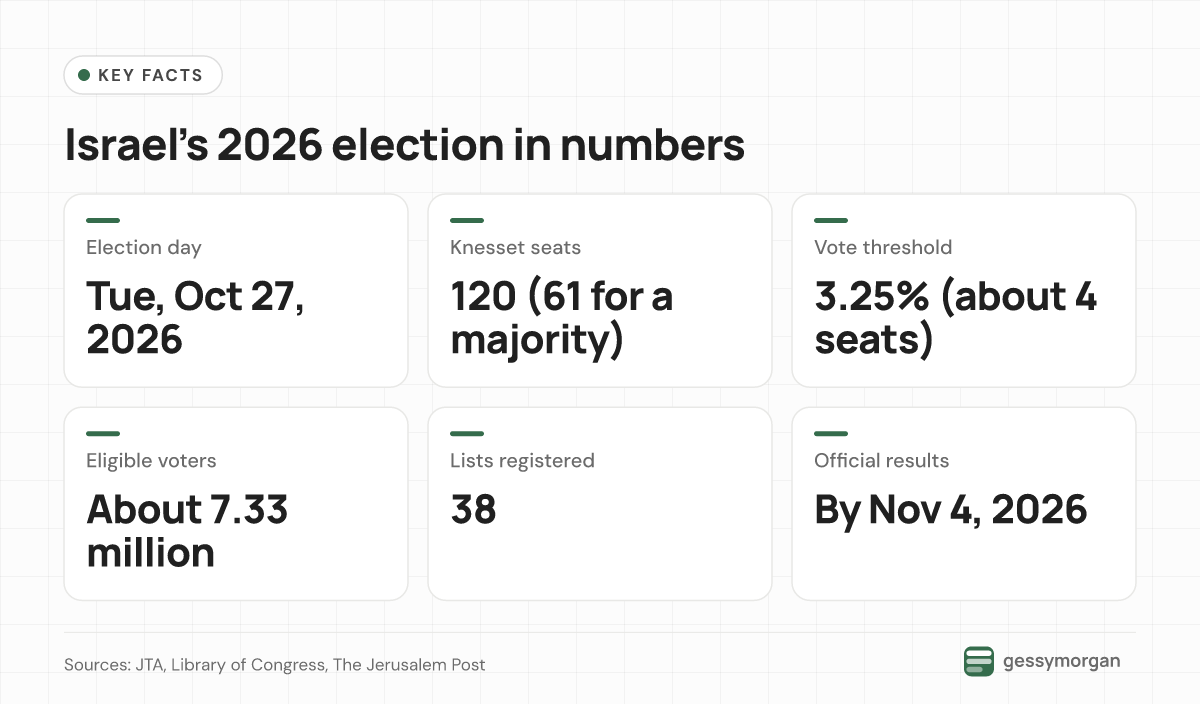
- Israel votes on Tuesday, October 27, 2026, for all 120 Knesset seats; polls are open from 7 a.m. to 10 p.m. at most stations.
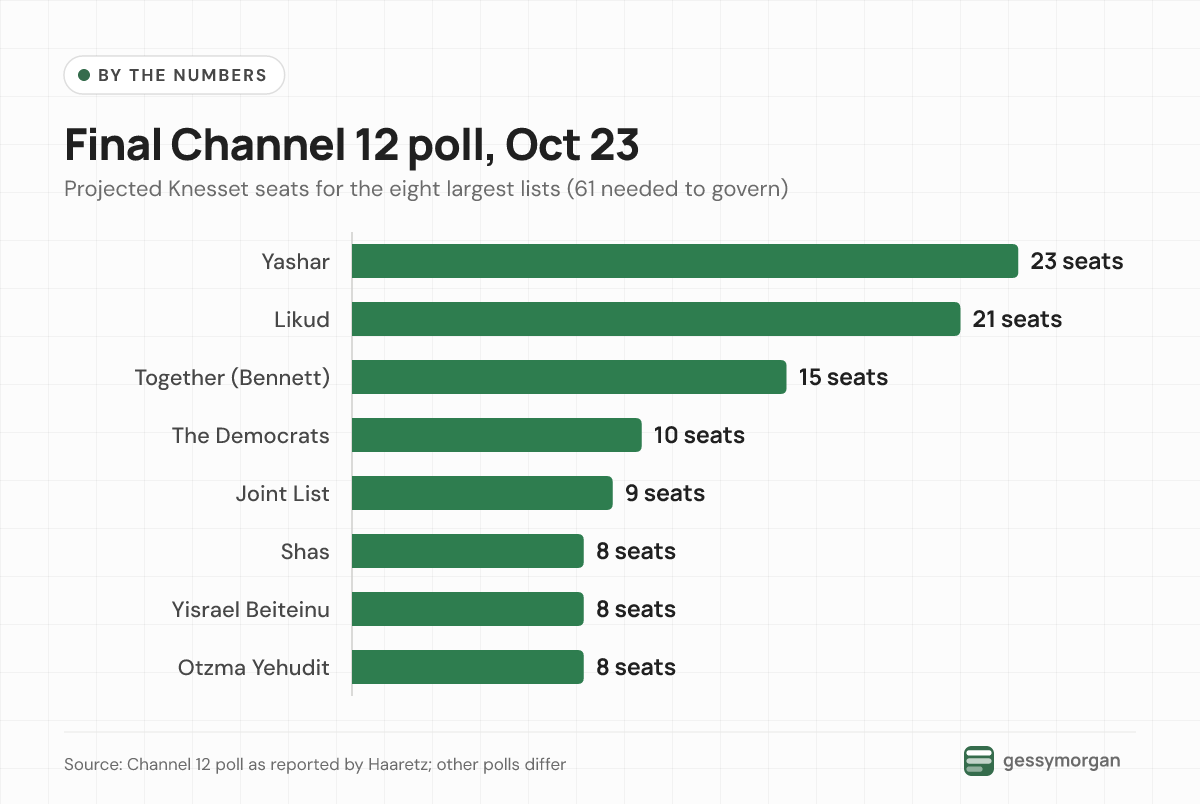
- Final TV polls put Gadi Eisenkot's Yashar first with 22 to 23 seats and Netanyahu's Likud second, but neither bloc reaches the 61 seats needed to govern.
- Official results are due by November 4, then President Herzog picks a nominee to try to build a coalition, a process that often takes weeks.
Israelis vote on Tuesday, October 27, 2026, to elect all 120 members of the Knesset, and the result will decide whether Benjamin Netanyahu stays on as prime minister or is replaced, most likely by former military chief Gadi Eisenkot. As of October 26, 2026, the final polls put Eisenkot's new Yashar party ahead of Netanyahu's Likud, but show neither camp reaching the 61 seats needed for a majority. That points to weeks of coalition bargaining after the vote.
When is the Israel election?
Election day is Tuesday, October 27. Most polling stations are open from 7 a.m. to 10 p.m., with shorter hours in small communities, hospitals and prisons, according to The Jerusalem Post's voter guide. Citizens aged 18 or over vote in person with an Israeli ID card, passport or driver's licence.
About 7.33 million people are eligible to vote, according to JTA's election explainer, which also says official results must be published by November 4. Turnout in 2022 was 70.63%.
Why Israel is voting now
This is a scheduled election rather than a snap one. The outgoing 25th Knesset is the first since 1988 to serve its full four-year term, and October 27 is the date set under the Basic Law, the Library of Congress law blog explains.
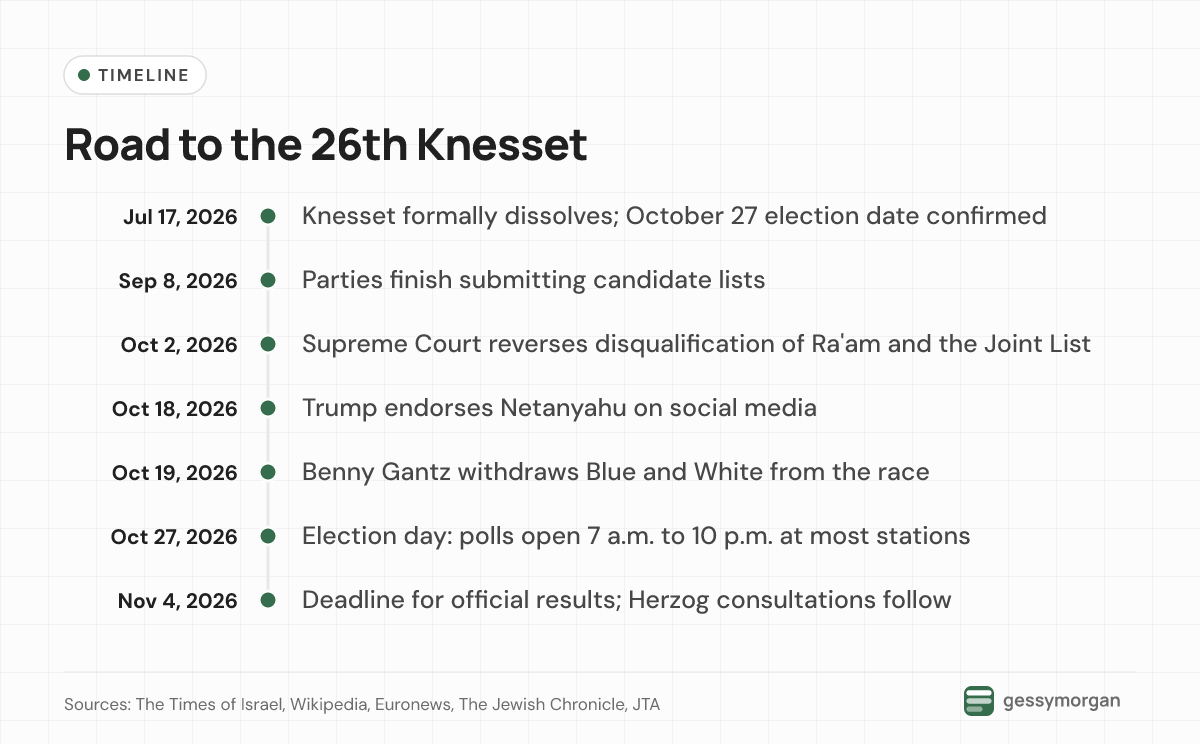
Lawmakers formally voted to dissolve on July 17, 2026, by 62 to 0, after the coalition attached the motion to a party-funding bill, The Times of Israel reported. Al Jazeera described the term as dominated by the wars in Gaza, Lebanon and Iran, and by a fight over exempting ultra-Orthodox (Haredi) men from military service. It is also Israel's first national vote since the October 7, 2023 attacks, Euronews notes.
How the Knesset system works
- A vote for a party list: Israelis do not vote directly for prime minister. They choose a party list, and the whole country is one constituency.
- The threshold: A list needs at least 3.25% of valid votes, roughly four seats, to enter the Knesset. Votes for lists that fall short are effectively lost.
- Proportional seats: Seats are shared out in proportion to votes. Leftover votes are allocated through surplus-vote agreements between paired parties.
- Coalitions: No party has ever won 61 seats alone, so every government has been a coalition, according to the Library of Congress.
After the results, President Isaac Herzog consults every party and picks the lawmaker with the best chance of forming a government. That nominee gets 28 days, which can be extended by 14. If they fail, a second nominee gets 28 days, and then a majority of lawmakers can propose a third. If every attempt fails, Israel holds another election, the Israel Democracy Institute explains. IDI adds that no government in the past two decades has been sworn in less than 50 days after an election. Until then, the outgoing government stays on as a caretaker.
The main parties and blocs
There are 38 lists registered, and polls suggest about 11 will pass the threshold. JTA notes the camps are defined less by policy than by support for, or opposition to, Netanyahu.
Netanyahu's bloc
- Likud, led by Netanyahu, whose list also includes New Hope candidates.
- Shas (Aryeh Deri) and United Torah Judaism, the ultra-Orthodox parties.
- Religious Zionism (Bezalel Smotrich) and Otzma Yehudit (Itamar Ben-Gvir), on the far right.
The opposition led by Eisenkot
- Yashar, founded by Gadi Eisenkot in September 2025. Eisenkot was chief of staff of the Israel Defense Forces from 2015 to 2019.
- Together (B'Yachad), led by Naftali Bennett, a joint list with Yair Lapid's Yesh Atid.
- The Democrats (Yair Golan), a merger of Labor and Meretz, and Yisrael Beiteinu (Avigdor Liberman).
Arab-majority parties and the small lists
Ra'am, led by Mansour Abbas, and the Joint List are counted outside both blocs in most polls. The Central Elections Committee barred both in September, but the Supreme Court reversed that on October 2, according to the Wikipedia election page.
Benny Gantz pulled his Blue and White party out of the race on October 19 after months of polls showed it below the threshold, The Jewish Chronicle reported. "I will continue to fight for unity," Gantz said. Newer lists, including former general Ofer Winter's party and the Reservists list of Yoaz Hendel and Yaron Zelekha, are hovering near the 3.25% line.
What the polls say
The last polls from Israel's three main TV channels, released on October 23, all put Yashar first: 23 seats on Channel 12 and 22 on both Channel 13 and Kan. Likud was second with 19 to 21 seats, Haaretz reported. The Eisenkot bloc had 52 to 56 seats and Netanyahu's bloc 50 in each poll, with the Arab-majority parties on 14 to 16.
A Jerusalem Post average of four polls gave the opposition 54 seats and Netanyahu's bloc 49.5. Pollsters do not all agree, and the gap between the blocs is only a few seats. Polls are estimates, not results.
What each side is arguing
Netanyahu and Likud
Netanyahu says the race is close and urges right-wing voters not to back small parties that may miss the threshold. "We mustn't squander the Right's votes," he said, according to The Jerusalem Post. Likud billboards use the slogan "Right or Palestine," arguing that an opposition win would lead toward a Palestinian state and depend on Arab parties.
Netanyahu has said Ben-Gvir would be a senior minister in his next cabinet and has denied he would form a government with Eisenkot, Ynet reported. US President Donald Trump endorsed him on October 18, writing that the wrong leader "would be anyone other than Bibi," Euronews reported.
Eisenkot and Yashar
Eisenkot argues that Netanyahu's government failed on security and on drafting Haredi men. Yashar opposes a Palestinian state, would cap Torah-study exemptions from service at 3% of each yearly Haredi cohort, and promises to ease the cost of living, according to The Jerusalem Post's summary of its platform.
At his final rally on October 25, he told supporters "Netanyahu wants a tie" and urged them to make Yashar far bigger than Likud, The Times of Israel reported.
The Arab-party question
Without a majority, any opposition government would probably need Arab parties' support or abstention. Bennett has said "the Arab parties are not Zionist, and therefore we will not rely on them," as the Arab Center Washington DC noted. The Jerusalem Post reports that Eisenkot rules out Ra'am and the Joint List as partners, though he has discussed a minority government that could pass if Arab parties abstain.
What happens after the vote
- Election night: Polls close at 10 p.m. and TV channels release exit polls.
- By November 4: Official results are published.
- Within seven days of results: Herzog consults the parties and names a nominee. He has said Trump's endorsement will not affect his choice, according to The Times of Israel's explainer.
- About two weeks after the vote: The new Knesset is sworn in and can pass laws before a government exists.
- Coalition talks: If no one can form a government, Israel heads to another election.
Our take
On the final polls, the most likely outcome is not a clear winner but a negotiation. Small lists near the threshold could swing several seats either way, and the opposition's handling of the Arab parties may decide whether it can govern. Until a new coalition wins a Knesset vote, Netanyahu stays in office as caretaker, so a narrow or inconclusive result favours the status quo for weeks.
For another tight election this week, see our Brazil election 2026 explainer. US readers can find dates and polling-place help in our Election Day 2026 guide.
Frequently asked questions
When is the Israel election 2026?
The election is on Tuesday, October 27, 2026. Most polling stations open at 7 a.m. and close at 10 p.m. Official results must be published by November 4.
Who is Gadi Eisenkot?
Gadi Eisenkot was chief of staff of the Israel Defense Forces from 2015 to 2019 and later served in the Knesset. He founded the Yashar party in September 2025 and leads the opposition camp in the polls.
Who is leading in the Israel election polls?
As of October 26, 2026, the final polls from Channels 12, 13 and Kan put Yashar first with 22 to 23 seats and Likud second with 19 to 21. Eisenkot's bloc leads Netanyahu's by two to six seats, but neither reaches 61. Polls are estimates, not results.
How is Israel's prime minister chosen?
Voters pick party lists, not a prime minister. After the results, the president consults the parties and asks one lawmaker to form a coalition that can win a Knesset majority vote. The nominee has 28 days plus a possible 14-day extension.
What happens if no one can form a government?
A second nominee gets 28 days, and then a majority of lawmakers can propose a third candidate. If all attempts fail, the Knesset dissolves and a new election is held. The outgoing government stays on as caretaker in the meantime.
Sources
- 2026 Israeli legislative election, Wikipedia
- Last Polls Before Election Day Put Eisenkot Ahead, Both Sides Short of Majority, Haaretz
- Israel Election 2026: Gadi Eisenkot leads Benjamin Netanyahu but Knesset deadlock looms, The Jerusalem Post
- Israel's Election and Eisenkot's Arab Coalition Dilemma, Arab Center Washington DC
- Elections 101: Forming A Government After Elections, Israel Democracy Institute
- 2026 Israeli elections: What you need to know, Jewish Telegraphic Agency
- Knesset officially disperses, after coalition completes its drastic legislative blitz, The Times of Israel
- Israel headed for October election as parliament dissolved, Al Jazeera
- Israel election: Benjamin Netanyahu rallies the Right as Gadi Eisenkot eyes PM role, The Jerusalem Post
- Eisenkot warns at campaign rally: Netanyahu will 'stop at nothing' to stay in power, The Times of Israel
- Benny Gantz pulls out of 2026 Knesset election eight days before polling date, The Jewish Chronicle
- Israel Election 2026: What does Gadi Eisenkot's Yashar stand for?, The Jerusalem Post
- FALQs: Israel's Upcoming Election on October 27, 2026, Library of Congress
- Trump endorses Netanyahu nine days before Israeli election, breaking months of silence, Euronews
- Israel election enters final 24 hours: Netanyahu's digital blitz, Eisenkot's knockout bid, Ynet News
- Israel Election 2026: Guide for first-time voters ahead of Knesset elections, The Jerusalem Post
- 2026 Israeli elections: What you need to know, The Times of Israel
How we wrote this
GessyMorgan explainers are built from public reporting and official sources. This post draws on the 17 sources listed above, each linked where we use it. It was drafted with AI assistance and checked against those sources before publishing. We did not test products, attend events or interview anyone for this article. Facts are current as of October 26, 2026, and we update the post when they change.