Firoz Cachalia SAPS Reform Reset: The Police Plan Explained
Acting Police Minister Firoz Cachalia's Police Reset Agenda aims to rebuild SAPS, starting in 140 high-crime precincts. Here is what it includes, how it is funded, what critics say and the dates ahead.
- Acting Police Minister Firoz Cachalia's Police Reset Agenda, launched at the May 2026 budget vote, is a multi-year plan to rebuild SAPS around integrity, intelligence and investigations.
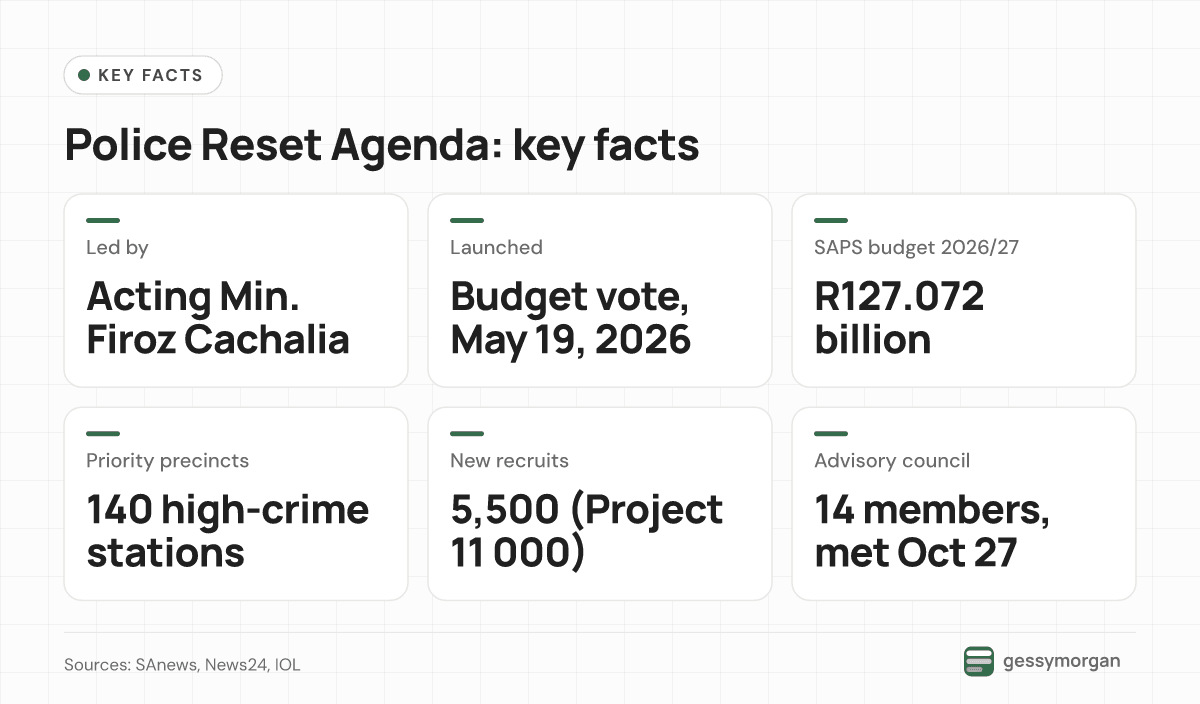
- Since July it has targeted 140 high-crime precincts, a Crime Intelligence rebuild, 5,500 recruits and four new provincial commissioners.
- On October 28 Cachalia said recovered criminal assets help fund the reset, after a 14-member advisory council met on October 27; the Madlanga Commission reports by January 25, 2027.
As of October 29, 2026, the Firoz Cachalia SAPS reform reset, formally called the Police Reset Agenda, is a multi-year plan to rebuild the South African Police Service around integrity, intelligence and investigations, starting in 140 high-crime police precincts. It is in the news because Acting Police Minister Firoz Cachalia told Daily Maverick on October 28 that money recovered from criminals, including State Capture loot, is helping to pay for it, a day after a new 14-member National Police Advisory Council met for the first time.
The reset runs alongside the Madlanga Commission, whose final report is due by January 25, 2027. Below: what the plan contains, progress since July, reactions and the dates to watch.
What is the Firoz Cachalia SAPS reform reset?
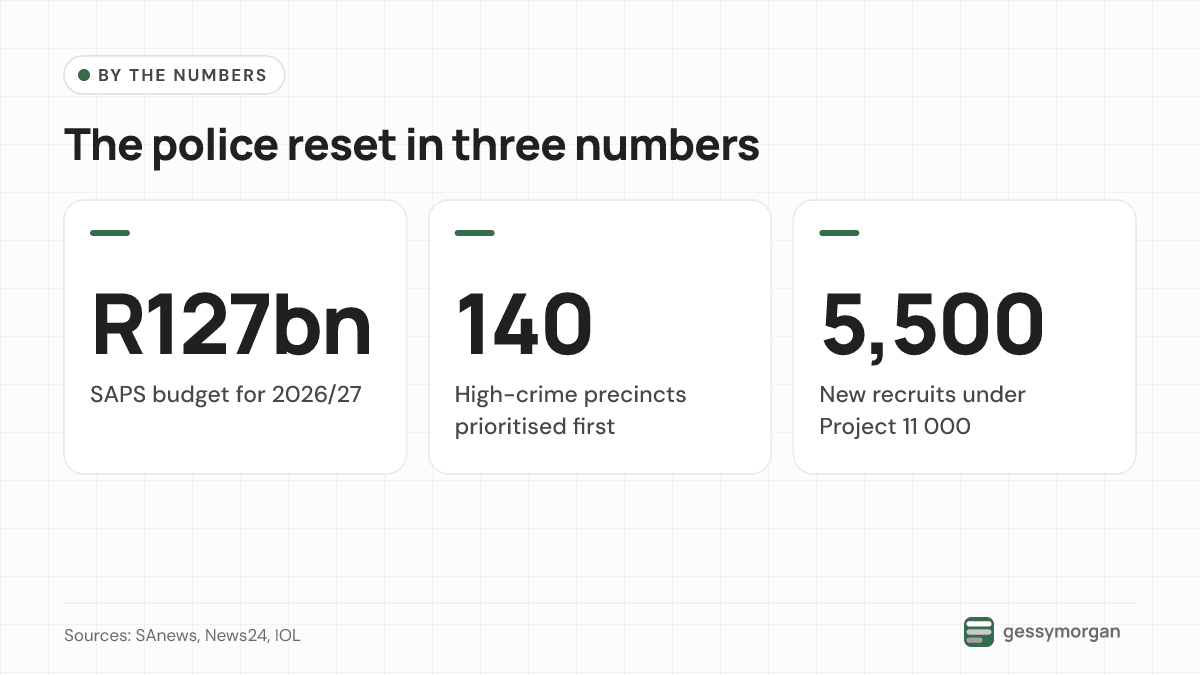
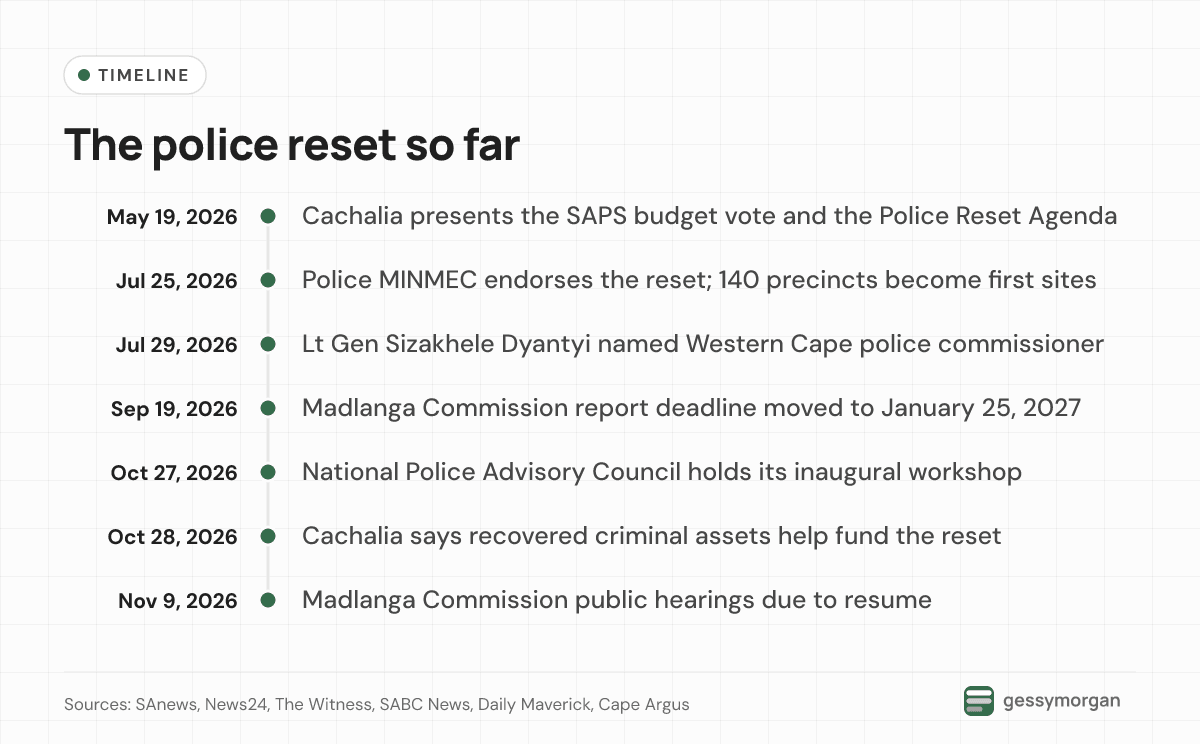
Cachalia introduced the Police Reset Agenda when he presented the SAPS budget vote in Parliament on May 19, 2026. According to SAnews, SAPS received R127.072 billion for 2026/27, projected to reach R135.8 billion by 2028/29. The budget was built around three focus areas: the integrity of the police service, its intelligence capability and its investigative capability.
Cachalia called it a multi-year turnaround, not a one-year fix. The May plan also covered procurement reform with National Treasury's Government Technical Advisory Centre, digitising police administration and assessments of the 50 highest-crime precincts. SAPS also set up a task team to follow up Madlanga Commission referrals, SAnews reported.
The stated goal, repeated at the July launch, is a police service that is "modern, intelligence-led, community-centred and technology-enabled," as News24 reported.
From plan to implementation: what has happened since July
The reset entered what Cachalia called its implementation phase after a two-day Police MINMEC meeting in White River, Mpumalanga, where the national ministry and every provincial MEC for community safety endorsed it. "The Police Reset Agenda is no longer a reform proposal. It has entered the implementation phase," he said on July 25, according to IOL and News24.
The main commitments announced at that meeting were:
- 140 high-crime precincts: the first implementation sites, due to get operational support, closer oversight, more resources, infrastructure upgrades and performance monitoring (up from 50 in May).
- Crime Intelligence: rebuilding the division and filling critical vacancies.
- 5,500 new recruits: under Project 11 000 (News24 calls them constables; IOL calls them recruits).
- Organised crime: a national strategy against cross-provincial syndicates, led by KwaZulu-Natal commissioner Lt Gen Nhlanhla Mkhwanazi, EWN reported.
- Integrity and oversight: stronger vetting, lifestyle audits and anti-corruption measures, plus a bigger role for civilian oversight.
New provincial commissioners followed within days. SAnews reported that appointments would be announced for the Western Cape, North West, Limpopo and Mpumalanga. In the Western Cape, Acting National Commissioner Lt Gen Puleng Dimpane named Lt Gen Sizakhele Dyantyi, who has 34 years of service, to take office on August 1, The Witness reported.
The Institute for Security Studies (ISS) noted in September that the list of 140 priority stations had not been published and that station commander vacancies were due to be filled in October.
The October 28 update: recovered funds and an advisory council
In the October 28 interview, Cachalia said assets recovered by the National Prosecuting Authority's Asset Forfeiture Unit and other bodies flow through the Criminal Assets Recovery Account (CARA) and are funding parts of the reset. Daily Maverick reported that the unit has seized and recovered more than R11 billion. Of the CARA money, R1 billion is earmarked for fighting organised crime and corruption, and a further R1 billion pays for the army's deployment to gang hotspots. "We strip them of their assets and use them," Cachalia said.
The police money is not new: Justice Minister Mmamoloko Kubayi first announced a R1 billion CARA allocation against organised crime in February, saying police planned to buy helicopters, Nyalas and technology, eNCA reported. Recovery totals also differ: in September, Kubayi put the unit's recoveries at R8.3 billion, according to the Cape Times, with no period stated.
The second part of the update is the National Police Advisory Council, which held its inaugural workshop on October 27. SAnews reported that its 14 members come from law, finance, law enforcement, academia and business, and that it will advise the minister and the National Commissioner, an idea first proposed in the 2012 National Development Plan. Cachalia listed near-term steps such as filling key vacant posts, better procurement, improved fleet management and station upgrades.
Daily Maverick reported that Cachalia wants work on known weaknesses, such as procurement and human resources, to begin before the Madlanga Commission concludes. On October 22 he told Parliament's Select Committee on Security and Justice that wider use of surveillance technology could improve community safety, EWN reported.
The Madlanga Commission context
The commission, chaired by retired Constitutional Court Justice Mbuyiseli Madlanga, is examining alleged infiltration of law enforcement, intelligence services, the prosecuting authority, the judiciary and prisons. President Cyril Ramaphosa set it up after Lt Gen Mkhwanazi made allegations at a media briefing in July 2025. It has sent two interim reports to the President but has not yet made final findings.
On September 19, the Presidency granted what it called a final extension, moving the report deadline from November 16, 2026 to January 25, 2027, SABC News and SAnews reported. Public hearings paused for October and are due to resume on November 9, after the November 4 local government elections, according to the Cape Argus. The paper reported that Police Minister Senzo Mchunu is expected to testify when hearings resume.
Mchunu has been on special leave since July 2025, which is why Cachalia is acting minister. In a parliamentary reply, Cachalia disclosed that the state had paid about R2.7 million towards Mchunu's legal costs, SABC News reported.
Reactions from parties, Parliament and analysts
Responses have focused mainly on delivery. Each view below is attributed to the person or group that expressed it.
- Democratic Alliance: on the day of the July launch, the DA's Ian Cameron said the plan overlooked the forensic DNA backlog and that "South Africa does not need another reset agenda that ignores the elephant in the room," The Star reported. On October 28, Cameron urged Ramaphosa to end the arrangement of an acting minister alongside a minister on leave: "There is no need for us to have two Ministers of Police."
- NCOP committee members: in early October, members of an NCOP committee criticised the ministry after Cachalia missed a briefing on Western Cape gang violence; the ANC's Phiroane Phala called it "a national crisis," the Cape Argus reported.
- Institute for Security Studies: researchers Anine Kriegler and Andrea Francke argued that the reset depends on the 140 station commanders, who "cannot be held responsible for problems they cannot resolve" without more authority and support.
- Academics: in an African Times opinion piece published on October 26, before the council's first workshop, UNISA criminology professor Jacob Tseko Mofokeng wrote that the advisory body's composition and mandate were still unclear, and that "prolonged uncertainty inevitably raises concerns about political will."
- Anti-corruption groups: speaking about asset recovery in general in September, OUTA chief executive Wayne Duvenage said "recovery cannot be the ultimate measure of success" without prosecutions and dismissals, the Cape Times reported.
Cachalia has framed the crisis as an opportunity, calling it "also a transformational moment" in Pietermaritzburg on October 1, The Witness reported. As of October 29, 2026, formal responses from other parties to the October 28 update had not been widely reported.
Our take
Based on the sources above, the parts of the reset that can be measured most easily are the 140 priority precincts, the 5,500 recruits and the leadership appointments. The unpublished station list makes independent tracking harder, a point the ISS raised. The bigger unknown is the Madlanga Commission's final report, which could recommend changes that reshape the reset after January 2027.
Key dates and how to follow it
- November 4, 2026: local government elections.
- November 9, 2026: Madlanga Commission public hearings are due to resume.
- January 25, 2027: deadline for the commission's final report to the President.
- Ongoing: station commander appointments, training of the 5,500 recruits, and the advisory council's first recommendations.
Official updates come from the Ministry of Police and SAPS and are carried by the government news agency SAnews. Dates may move, so check the latest statements.
Frequently asked questions
What is the SAPS Police Reset Agenda?
It is Acting Police Minister Firoz Cachalia's multi-year plan to reform the South African Police Service, presented at the May 2026 budget vote. It focuses on integrity, intelligence and investigations, starting with 140 high-crime precincts. MINMEC endorsed it on July 25, 2026, and Cachalia said it had entered implementation.
Why is Firoz Cachalia the acting police minister?
President Cyril Ramaphosa placed Police Minister Senzo Mchunu on special leave in July 2025, after allegations made by KwaZulu-Natal police commissioner Lt Gen Nhlanhla Mkhwanazi. Cachalia has acted in the post since then. The Madlanga Commission is examining the allegations and has not yet made final findings.
How is the police reset being funded?
It runs on the SAPS budget of R127.072 billion for 2026/27, plus money from the Criminal Assets Recovery Account. Cachalia told Daily Maverick on October 28 that recovered criminal assets, including State Capture loot, help fund it, with R1 billion earmarked for fighting organised crime and corruption. That R1 billion was first announced in February 2026.
What is the National Police Advisory Council?
It is a 14-member body, first proposed in the 2012 National Development Plan, that advises the Police Minister and the SAPS National Commissioner. It held its inaugural workshop on October 27, 2026. Its members come from law, finance, law enforcement, academia and business.
When is the Madlanga Commission final report due?
The Presidency set a final deadline of January 25, 2027, moved from November 16, 2026. Public hearings are due to resume on November 9, 2026. Dates can change, so check official statements.
Sources
- SAPS receives R127bn budget as Cachalia unveils police "reset agenda", SAnews
- South Africa: R1bn in Recovered Loot to Fund Firoz Cachalia's Police Reset, Daily Maverick (via AllAfrica)
- 'Reset Agenda': Four new provincial police commissioners to be appointed, says Cachalia, News24
- Cachalia unveils SAPS reset plan aimed at tackling crime and rebuilding trust, IOL
- Cachalia issues reset warning, EWN
- Four Provincial Commissioners to be announced this week, SAnews
- New Western Cape police commissioner appointed as gang violence persists, The Witness
- South Africa's Police Reset Depends On 140 Station Commanders, Institute for Security Studies (via AllAfrica)
- Police advisory council to support policing reforms and restore public trust, SAnews
- President extends Madlanga Commission's final report deadline, SAnews
- Ramaphosa extends Madlanga Commission's final report to January, SABC News
- Madlanga Commission shuts public hearings until November as final report deadline looms, Cape Argus
- DA calls on President Ramaphosa to resolve Police Ministry stalemate, SABC News
- Cachalia's promise of policing reset faces backlash over DNA backlog, The Star
- Police Ministry criticised after Cachalia misses Western Cape gang-violence meeting, Cape Argus
- Cachalia: Digital surveillance rollout key to boosting community safety, EWN
- R1bn allocated to bolster crime-fighting efforts, eNCA
- South Africa recovers R8.3bn in corruption proceeds, but accountability remains elusive, Cape Times
- The Cost of Inertia: Why the Stalled Police Advisory Board Leaves SAPS Trapped in Operational Quicksand, African Times
- WATCH: Cachalia: SA policing faces transformational moment, The Witness
How we wrote this
GessyMorgan explainers are built from public reporting and official sources. This post draws on the 20 sources listed above, each linked where we use it. It was drafted with AI assistance and checked against those sources before publishing. We did not test products, attend events or interview anyone for this article. Facts are current as of October 29, 2026, and we update the post when they change.