Digital Passports and Airport Biometric Security in South Africa
South Africa has no digital passport yet. Here is what Home Affairs, the BMA and ACSA have officially said about the planned ePassport, face checks at airports and eGates, with dates and what travellers should do now.
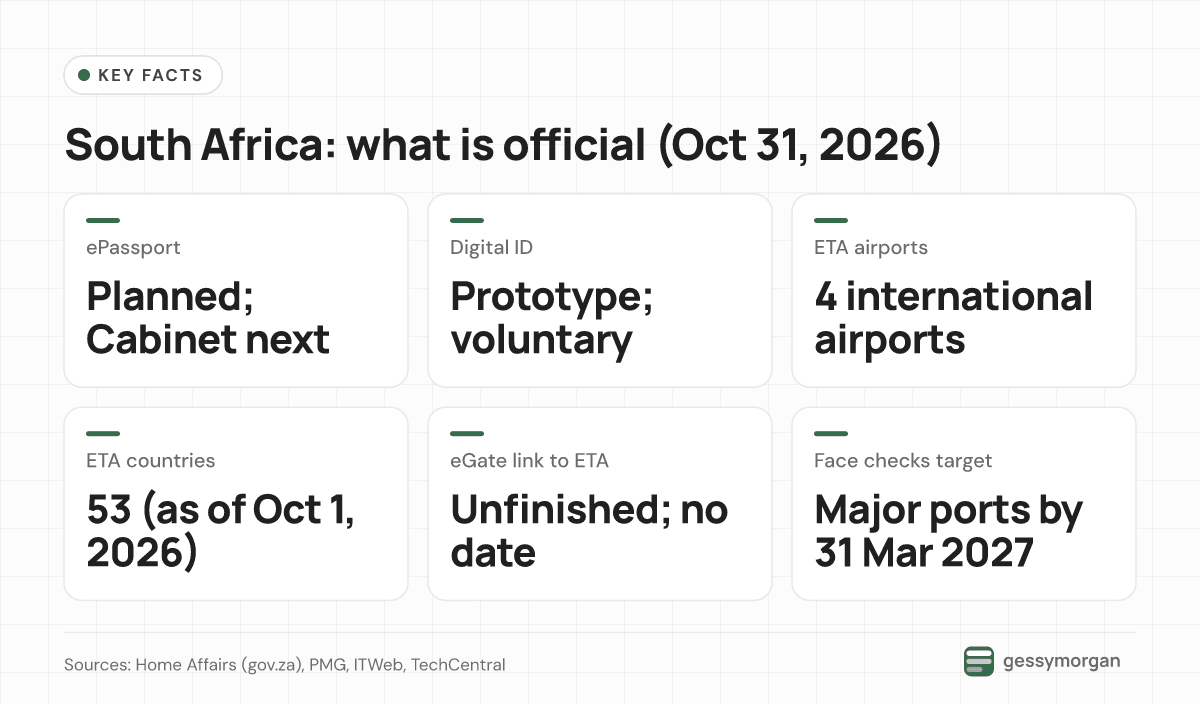
- As of October 31, 2026, South Africa has no digital passport: Home Affairs plans a chip-based ePassport, but the proposal has not yet gone to Cabinet and has no launch date.
- Facial verification already runs for foreign visitors at OR Tambo, Cape Town, King Shaka and Lanseria through the ETA and the BMA's EMCS 2.0, at staffed immigration counters.
- Linking those checks to ACSA's airport eGates is unfinished; the official target is the ETA and EMCS 2.0 at all major ports of entry by March 31, 2027.
South Africa does not have digital passports yet, and no new airport eGate system has gone live. As of October 31, 2026, the official picture on digital passports and airport biometric security is this: Home Affairs plans a chip-based ePassport but has not yet taken it to Cabinet, the Border Management Authority (BMA) already checks visitors' faces at four international airports, and linking those checks to the eGates owned by Airports Company South Africa (ACSA) is still unfinished.
Interest rose after IATA published a global survey on October 28 showing strong demand for digital passports, and after Home Affairs said on October 29 that biometric checks now close a passport-fraud loophole. Neither set a new South African launch date.
What South Africa has announced on digital passports and airport biometric security
The clearest statement came from Home Affairs Minister Leon Schreiber at Constitution Hill on October 1, 2026. In his keynote address, he said Home Affairs and Government Printing Works are working together on the country's first biometrically secured ePassport. Passport processing will be fully automated first, and only then will a proposal go to Cabinet.
The proposed passport would carry a secure chip holding the holder's biometrics. Schreiber said this would make the passport "readable by electronic gates at airports around the world" for the first time, helping Home Affairs negotiate visa-free access to more countries. He gave no launch date.
The minister also demonstrated a prototype of a separate, voluntary digital ID in the MyMzansi app, sharing selected details by QR code, TechCentral reported. It is an identity credential, not a travel document, and no airport use has been announced. TechCentral cited a departmental plan for credentials in the 2027/28 financial year, while Biometric Update noted President Cyril Ramaphosa's pledge of a launch before the end of 2026.
What already runs at airports: the ETA and EMCS 2.0
The biometric system in use today is aimed at foreign visitors. President Ramaphosa launched the Electronic Travel Authorisation (ETA) at OR Tambo International Airport on August 12, 2026, as the Presidency had announced. It is live at OR Tambo, Cape Town International, King Shaka International and Lanseria International.
Applicants register on eta.dha.gov.za, scan their passport and take a selfie, which is matched against the passport photo. In his launch speech, Schreiber said the scan checks more than 40 passport features and that approved authorisations arrive within 24 hours and can be kept in a phone wallet. By October 1, the ETA covered short-stay visa applications from 53 countries, with more being added every week.
At the border, the BMA and the South African Revenue Service (SARS) have upgraded the movement control system to EMCS 2.0, which uses facial verification. Visitors look into a camera at the immigration counter on arrival, and ETA holders are checked again at the departure counter, which lets Home Affairs spot overstays. ITWeb reported that 6,126 fraudulent applications, about 2.8% of submissions from the pilot countries, had been rejected, and Schreiber put total applications at 216,204.
Airport eGates: where things stand
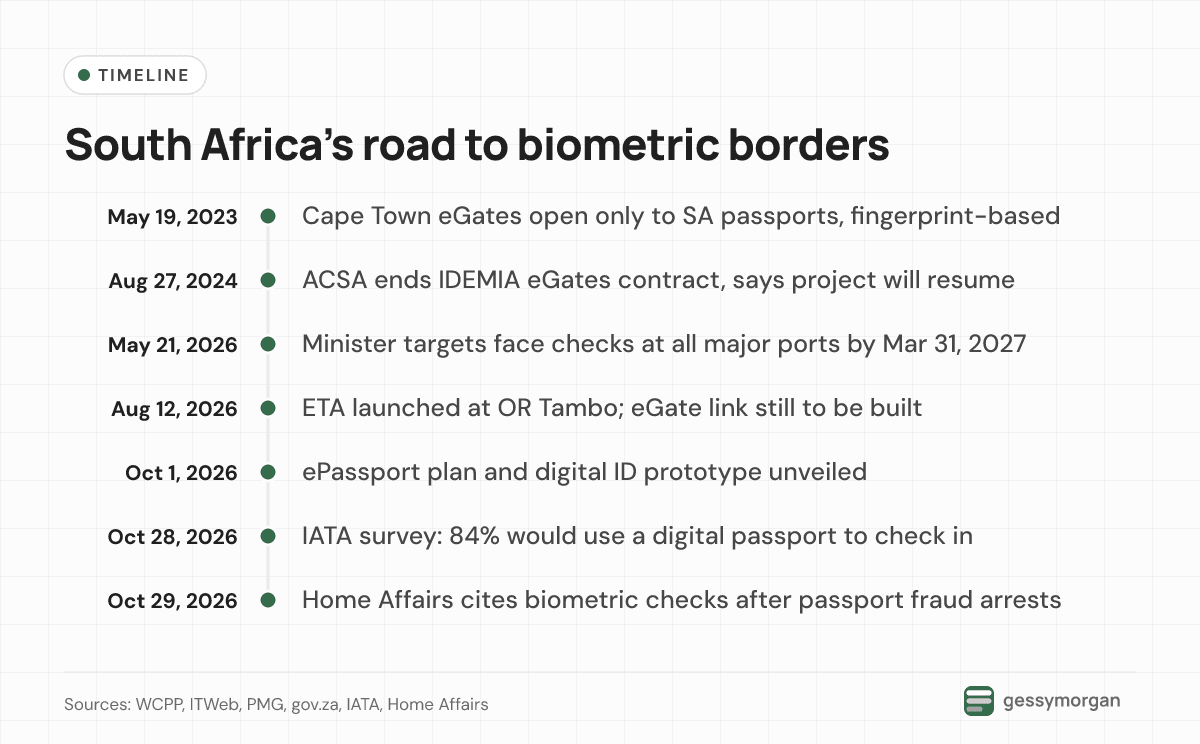
For now, ETA travellers and their face checks still go through staffed counters. At the August launch, Schreiber said "we now need to also link the ETA and EMCS 2.0 to eGates, which are owned by ACSA", and urged ACSA, the BMA, Home Affairs and SARS to speed up the work. Once linked, he said, the gates would end manual passport stamping and use facial recognition to process South African citizens and ETA visitors. As of October 31, no completion date has been announced.
eGates are not new. A 2023 reply in the Western Cape legislature said ACSA piloted eGates at Cape Town International in 2020. They read fingerprints, were open only to South African passport holders and suffered read errors linked to IT integration with Home Affairs systems.
A larger upgrade stalled in 2024. On August 27, 2024, ACSA ended its automated border control, eGates and single-token contract with IDEMIA after alleged irregularities in the award, which both companies had initially denied, ITWeb reported. ACSA said the project remained key to its strategy and that it intended to pursue it in the near future.
Beyond airports, the October 1 speech said the BMA will pursue automated gates and gantries at all ports of entry once the ETA is fully rolled out, opening only when a foreign traveller's biometrics match their ETA. "You cannot bribe a computer," Schreiber said. In a May 2026 written reply to Parliament, he said the ETA and EMCS 2.0, with facial verification, are expected at all major ports of entry by March 31, 2027. That is a target, not a guarantee.
Why passport fraud is part of the story
Home Affairs presents these upgrades as an anti-fraud measure. On October 29, the department announced three more arrests: two former officials and a member of the public, over 10 passport applications processed in 2023 at its Bothaville office in the Free State by swapping photos. The case was postponed to January 20, 2027, and the accused have not been convicted.
The department said biometric verification now closes some of those gaps. TimesLIVE reported its totals since July 2024: 44 arrests and 98 dismissals.
The global push for digital passports
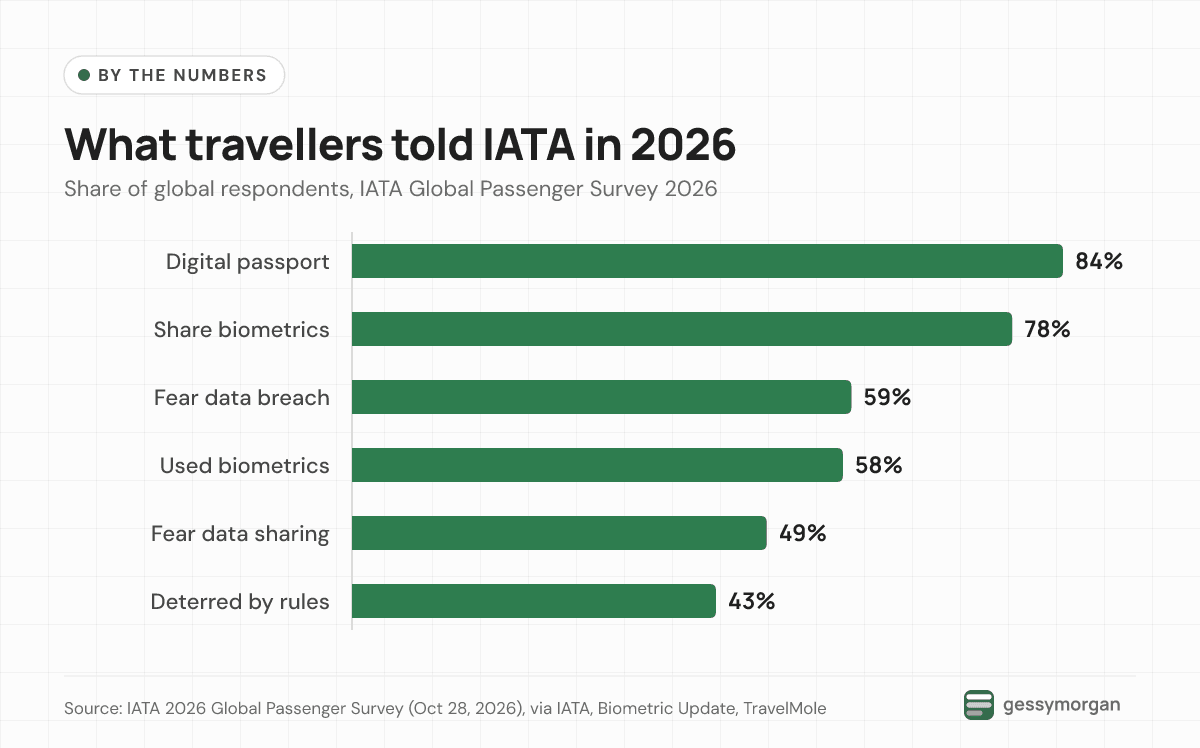
IATA's 2026 Global Passenger Survey, released on October 28 with more than 10,000 respondents, found that 58% of travellers used biometrics at an airport in the past year, up from 50% in 2025. Some 84% said they would use a digital passport for online check-in, and 78% would share biometric data to skip repeated document checks. IATA urged governments to agree a common way to issue and accept secure digital passports, known as Digital Travel Credentials.
Africa stood out: in IATA's regional table, 52% of African respondents said entry rules put them off travel, the highest of any region. Privacy worries are real too. Biometric Update and TravelMole reported that 59% of respondents worried about data breaches and 49% about their data being passed to other organisations.
Data protection: what the law says
South Africa's Protection of Personal Information Act (POPIA) treats biometric data as special personal information. "There is a general prohibition against processing SPI," Information Regulator spokesperson Nomzamo Zondi told TechCentral in September, in a case about police body cameras. Processing is allowed only under narrow exceptions.
Home Affairs says the ETA platform was built with POPIA compliance and cybersecurity safeguards in mind, Explain reported, while governance consultant Ayesha Kajee urged oversight by Parliament and civil society: "Monitor the monitors." For the digital ID, Schreiber promised hard limits on data use and a record of every access.
What travellers should do now
- South African citizens: there is no ePassport to apply for. Keep using your current passport; Home Affairs has not announced any change to its validity. Schreiber said on October 1 that passport applications will "shortly" be offered at the bank branches that already handle Smart IDs.
- Foreign visitors: if your country is on the ETA list, apply only through the Home Affairs ETA site named in the minister's speech, and expect a face check at the immigration counter on arrival and departure.
- Everyone: carry your physical passport. The ETA can sit in a phone wallet, but SAnews explains that it is tied to the holder's passport.
Our take
Based on the official record, South Africa is building airport biometric security in stages. Face checks for visitors are live, the eGate link is the next practical step, and a chipped ePassport depends on Cabinet. Given the 2023 Cape Town eGate problems and the 2024 contract collapse, the signal to watch is a joint ACSA and BMA announcement that eGates are working with ETA data.
What to watch next
- A Home Affairs, BMA or ACSA statement that eGates are connected, with airports and start dates.
- A Cabinet decision on the ePassport proposal; no date has been given.
- Early 2027: study and work visas are due to be added to the ETA.
- March 31, 2027: the target for the ETA and EMCS 2.0 at all major ports of entry.
- Final digital ID regulations and a public launch date.
Frequently asked questions
Does South Africa have digital passports?
No. As of October 31, 2026, Home Affairs is working with Government Printing Works on a chip-based ePassport, but the minister said the proposal will go to Cabinet only after passport processing is fully automated. No launch date has been announced, and current passports remain in use.
Can South Africans use eGates at airports?
Cape Town International piloted fingerprint eGates for South African passport holders from 2020, but a 2023 provincial reply described read errors linked to IT integration. Home Affairs says the eGates, which ACSA owns, still need to be linked to the ETA and EMCS 2.0 before they can process travellers by facial recognition. No completion date has been given.
What is South Africa's ETA and who needs it?
The Electronic Travel Authorisation is an online visa system for foreign visitors, launched on August 12, 2026 and live at OR Tambo, Cape Town, King Shaka and Lanseria. Applicants submit a passport scan and a selfie, and approvals are issued within 24 hours. It is being made mandatory gradually for short-stay visitors from countries that need visas, and is optional for visa-exempt travellers.
Is my face data protected at South African airports?
POPIA treats biometric data as special personal information that may be processed only under narrow exceptions, and the Information Regulator said in September that even the police have no blanket exemption. Home Affairs says the ETA was built with POPIA compliance and cybersecurity safeguards. You can raise concerns with the Information Regulator.
When will the South African ePassport be available?
There is no official date. Home Affairs has described the steps as automating passport processing, then taking a proposal to Cabinet, then negotiating more visa-free access. Some media reports have mentioned a two-year timeline, but that figure does not appear in the minister's published speech.
Sources
- Minister Leon Schreiber: Home Affairs Quantum Leap: A Vision for the Future of Government, South African Government (gov.za)
- Minister Leon Schreiber: Launch of South Africa's Electronic Travel Authorisation, South African Government (gov.za)
- President Ramaphosa to officially launch South Africa's Electronic Travel Authorisation, The Presidency
- Three more arrested for passport photo-swapping fraud as Home Affairs shuts down corruption loopholes, Department of Home Affairs
- Question to the Minister of Home Affairs - NW2572, Parliamentary Monitoring Group
- Digital travel system takes off at four SA airports, ITWeb
- ACSA terminates biometrics contract over irregularities, ITWeb
- Question 17: eGates at Cape Town International Airport (reply by Minister Mireille Wenger), Western Cape Provincial Parliament
- South Africa's digital ID is here, TechCentral
- Saps bodycam tender collides with Popia's biometrics rules, TechCentral
- South Africa unveils digital ID prototype, issues first credential, Biometric Update
- IATA's 2026 Global Passenger Survey: Travelers Embrace Biometrics and AI but Entry Requirements Remain a Barrier, IATA
- IATA survey finds growing demand for biometrics as travel barriers persist, Biometric Update
- IATA's 2026 Global Passenger Survey: AI, biometrics surge but visa rules deter 43% of travelers, TravelMole
- South Africa's new ETA puts your face at the border, Explain
- Home affairs corruption arrests rise to 44 as three more arrested, TimesLIVE
- SA rolls out Electronic Travel Authorisation, SAnews
How we wrote this
GessyMorgan explainers are built from public reporting and official sources. This post draws on the 17 sources listed above, each linked where we use it. It was drafted with AI assistance and checked against those sources before publishing. We did not test products, attend events or interview anyone for this article. Facts are current as of October 31, 2026, and we update the post when they change.