Bank of England Rate Decision, November 2026: What to Expect
The Bank of England sets interest rates at 12:00 GMT on Thursday, November 5, 2026. Bank Rate is 3.75% and a rise to 4% is widely expected. Here is the timing, the forecasts and what it means for mortgages and savings.
- The Bank of England announces its decision at 12:00 GMT on Thursday, November 5, 2026, with minutes and a new Monetary Policy Report.
- Bank Rate is 3.75%, and with inflation at 3.5% in September a rise to 4% is widely expected, though nothing is confirmed.
- Tracker and variable mortgages usually move first; fixed deals change when they end. MoneyHelper offers free, impartial guidance.
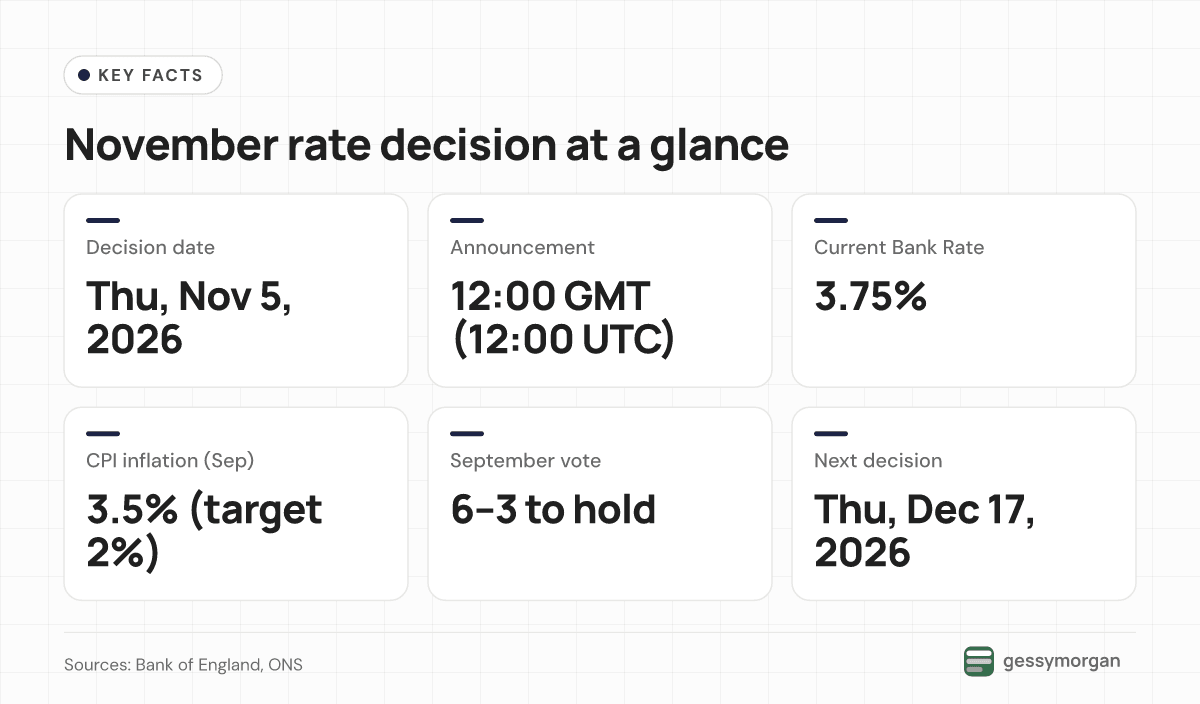
The Bank of England will announce its next interest rate decision at 12:00 noon GMT on Thursday, November 5, 2026. That is 12:00 UTC, 13:00 CET, 7 a.m. ET, 4 a.m. PT, 5:30 p.m. IST and 11 p.m. AEDT. Bank Rate stands at 3.75%, and the Monetary Policy Committee (MPC) is widely expected to raise it to 4%, which would be the first increase since August 2023.
Below is what is confirmed, what forecasters expect and what a change could mean for mortgages and savings, as of October 27, 2026. This is general information only, not financial advice.
When is the Bank of England's November 2026 decision?
The Bank's official MPC calendar lists Thursday 5 November as the next decision date. It is one of four meetings a year that come with a full Monetary Policy Report. The Bank's publications calendar says the November Report will be published at 12pm that day, alongside the Monetary Policy Summary and the minutes of the meeting.
- Date: Thursday, November 5, 2026
- Time: 12:00 GMT. UK clocks went back to GMT on October 25, according to GOV.UK, so UK time and UTC are the same.
- Other time zones: 13:00 CET, 07:00 ET, 04:00 PT, 17:30 IST, 23:00 AEDT. US clocks change on November 1, so New York is five hours behind London again by decision day (see our guide to the clock change).
- What is published: the decision and vote split, the minutes and the November Monetary Policy Report with new forecasts
- Next meeting after this one: Thursday, December 17, 2026
The result appears on the Bank's Bank Rate page as soon as it is announced. That page is the simplest official place to check the new rate.
What is Bank Rate now, and how did it get here?
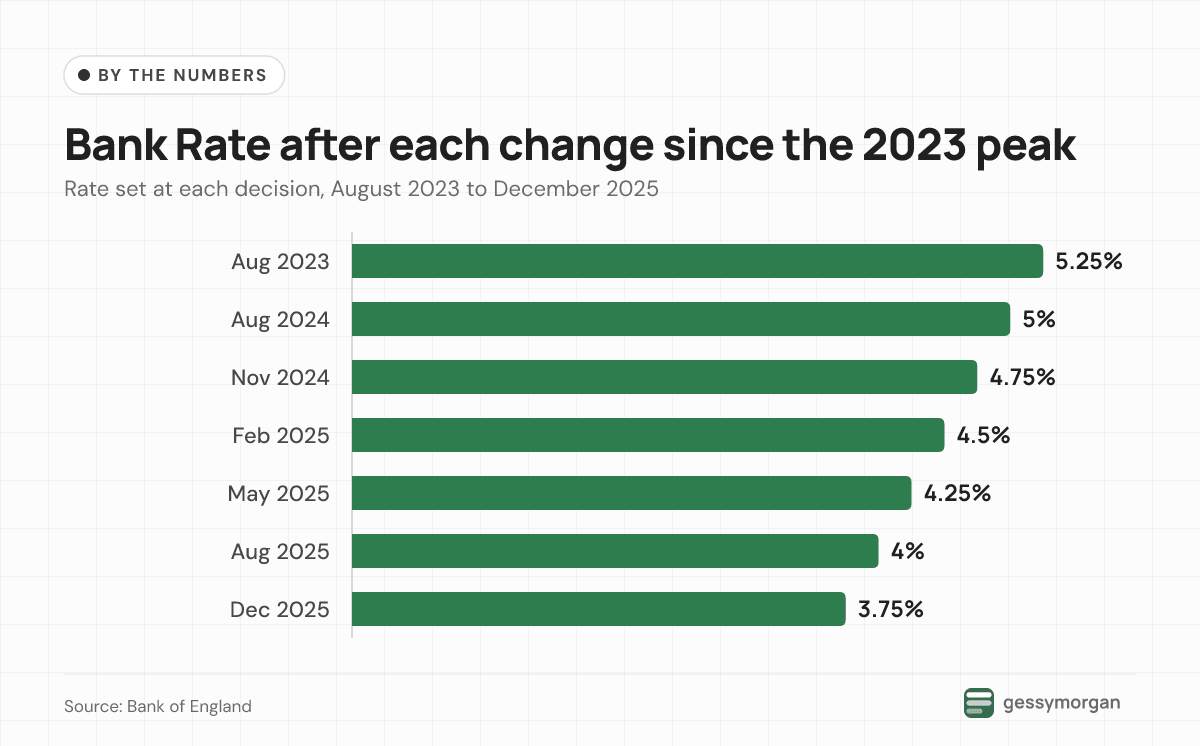
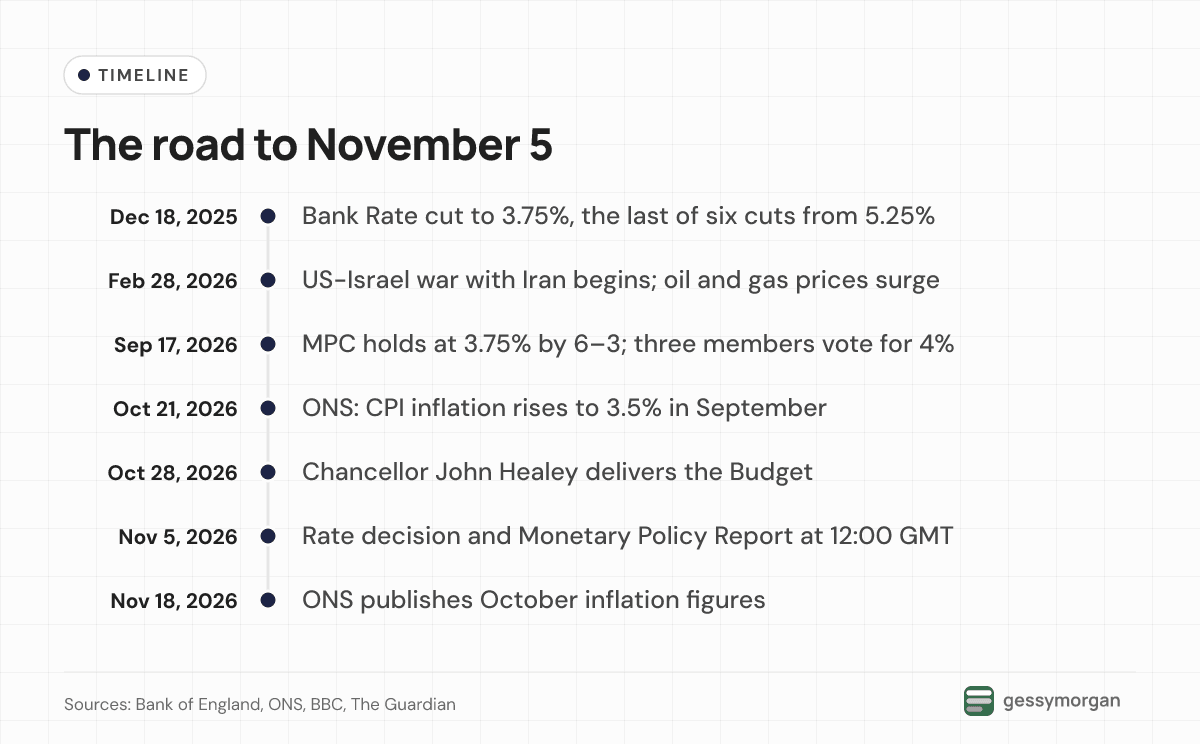
Bank Rate has been 3.75% since December 18, 2025, according to the Bank's official rate history. That was the last of six cuts from a peak of 5.25%, a level the Bank reached in August 2023 and held for a year.
The cuts stopped as the outlook changed in 2026. Oil and gas prices jumped after the US and Israel went to war with Iran at the end of February, The Guardian and the BBC report. The BBC's live coverage of the September decision called it the sixth hold in a row.
The September vote: 6–3 to hold
At its last meeting, which ended on September 16, the MPC voted 6–3 to keep Bank Rate at 3.75%, the September minutes show. Governor Andrew Bailey, Sarah Breeden, Swati Dhingra, Clare Lombardelli, Dave Ramsden and Alan Taylor voted to hold. Megan Greene, Catherine L Mann and Huw Pill wanted a quarter-point rise to 4%.
The majority accepted that energy costs would keep inflation above target for longer, but saw little sign yet of so-called second-round effects, where firms and workers push up other prices and wages in response. The three dissenters preferred to act early as insurance. Bailey said that if the conflict lasts a long time, policy "may have to tighten", the BBC reported.
Why a rate rise is now expected
Inflation has moved further from the Bank's 2% target. On October 21 the Office for National Statistics (ONS) said consumer prices rose 3.5% in the 12 months to September, up from 3.1% in August. Core inflation, which leaves out energy, food, alcohol and tobacco, rose to 2.8% from 2.6%. Services inflation, which the Bank watches closely, rose to 3.7% from 3.4%.
Motor fuel was the biggest driver. The ONS said fuel prices were 29.8% higher than a year earlier, with petrol averaging 169.5p a litre and diesel 192.5p in September. The Guardian noted that the 3.5% figure beat City forecasts of 3.4%.
The Bank had flagged this risk. Its September minutes projected inflation of about 3¾% in the last three months of 2026 and slightly above 4% early in 2027. The Committee also noted that household mortgage rates and business borrowing costs were already higher than before the conflict began.
What forecasters and markets expect
The Bank is widely expected to raise rates to 4% on November 5, The Guardian reported on October 25. The Financial Times said the September inflation figure would cement expectations of a November rise. Neither outcome is confirmed until the Bank announces it.
Views differ on what follows. Prices in financial markets imply at least four quarter-point rises over the next year, taking Bank Rate to 4.75% by the end of July 2027 and possibly 5% by December 2027, according to the Guardian. Several City economists quoted in the same report think that goes too far:
- Deutsche Bank expects Bank Rate to reach 4.25% by February 2027 and stay there until the end of 2027.
- Morgan Stanley has a base case of rises in November and February, then a pause.
- Oxford Economics forecasts quarter-point rises in November and February, to 4.25%.
- Goldman Sachs expects 4% in November but a path "notably below market pricing".
- ING's James Smith suggested the Bank could be cutting again by the end of 2027.
Forecasts are not guarantees. A sharp fall in oil prices or weak economic data could change the MPC's thinking. Chancellor John Healey's Budget on October 28 also lands a week before the decision.
What a change would mean for mortgages and savings
Bank Rate shapes what lenders charge and what savers earn, but banks set their own rates. The government-backed MoneyHelper service, whose guide was updated after the September decision, says the effect depends on the product you have:
- Tracker mortgages follow Bank Rate plus a set margin, so a 0.25 percentage point rise in Bank Rate raises the rate you pay by the same amount.
- Standard variable rate (SVR) mortgages are set by each lender, which will usually pass on a change, sometimes from the next payment. Your lender should write to explain any new rate.
- Fixed-rate mortgages stay the same until the fixed period ends. New fixed deals depend partly on where markets expect rates to go, so they can move before the Bank acts.
- Savings rates may rise after a Bank Rate increase, but banks do not always pass changes on automatically.
If you are worried about payments or a deal that ends soon, MoneyHelper offers free, impartial guidance online and by phone. It also explains the Mortgage Charter, a set of commitments most UK lenders have signed. Talk to your lender or a regulated adviser before making decisions. Nothing here is a recommendation to fix, switch or save.
Shoppers planning big purchases may also want to read our guides to Black Friday 2026 and Cyber Monday 2026, which cover official dates and how to avoid scams.
What to watch for on November 5
- The decision and the vote: a rise to 4% would be the first increase since August 2023. A split vote, in either direction, hints at how united the Committee is about next steps.
- The Monetary Policy Report: new forecasts for inflation, growth and jobs, and the Bank's view of energy prices.
- The guidance: whether the MPC hints at the run of rises markets have priced in, or at a short cycle, as many economists expect.
- The next data: the ONS publishes October inflation on November 18, and the MPC's final decision of 2026 is due on December 17.
How to follow it
The Bank posts the decision, minutes and Monetary Policy Report on its website at 12:00 GMT. UK broadcasters and newspapers usually run live coverage, as the BBC did for the September decision. Markets react quickly: after the September decision, UK government bond yields fell, the BBC reported, partly because the Bank also changed its bond-sales plan.
Our take
Based on the sources above, the November 5 question looks less like "will the Bank raise rates?" and more like "how far will it signal it is prepared to go?" The gap between market pricing, which points to 4.75% or higher, and economists' forecasts of around 4.25% is wide. The tone of the new Report may affect mortgage pricing as much as the decision itself.
For households, the practical point is timing. Tracker and SVR borrowers feel a change soonest, fixed-rate borrowers feel it when their deal ends, and savers may only benefit if they check their rate. MoneyHelper is the best free place to start.
Frequently asked questions
What time is the Bank of England interest rate announcement on November 5, 2026?
The Bank publishes its decision, the minutes and the November Monetary Policy Report at 12:00 noon UK time on Thursday, November 5, 2026. The UK is on GMT by then, so that is 12:00 UTC, 7 a.m. ET, 5:30 p.m. IST and 11 p.m. AEDT.
What is the Bank of England base rate now?
As of October 27, 2026, Bank Rate is 3.75%. It has been at that level since a cut on December 18, 2025, and the MPC voted 6–3 to hold it in September 2026.
Will the Bank of England raise interest rates in November 2026?
Nothing is confirmed until the announcement. After inflation rose to 3.5% in September, the Bank is widely expected to raise Bank Rate to 4%, according to The Guardian and the Financial Times. Markets also price further rises in 2027, though many economists expect fewer.
How would a Bank Rate rise affect my mortgage?
According to MoneyHelper, tracker mortgages usually rise by the same amount as Bank Rate, and lenders often pass changes on to standard variable rates. Fixed-rate payments stay the same until the deal ends. For guidance on your situation, contact your lender or MoneyHelper.
When is the next Bank of England meeting after November 2026?
The MPC's final decision of 2026 is on Thursday, December 17. The first decisions of 2027 are on February 4 and March 18, according to the Bank's official calendar.
Sources
- Monetary Policy Committee dates for 2026 and 2027, Bank of England
- Interest rates and Bank Rate, Bank of England
- Bank Rate maintained at 3.75% - September 2026 Monetary Policy Summary and Minutes, Bank of England
- Official Bank Rate history, Bank of England
- Upcoming events and publications, Bank of England
- Consumer price inflation, UK: September 2026, Office for National Statistics
- Petrol and diesel price rises push UK inflation higher, BBC News
- Bank of England holds interest rates at 3.75%, but governor says high energy costs may lead to increase, BBC News
- Double blow to Healey as inflation rises to 3.5% and monthly deficit hits £24bn, The Guardian
- Interest rates unlikely to reach 4.75% by next summer, say City economists, The Guardian
- UK inflation and borrowing top forecasts in blow to John Healey, Financial Times
- How will interest rates affect my mortgage?, MoneyHelper (Money and Pensions Service)
- When do the clocks change?, GOV.UK
How we wrote this
GessyMorgan explainers are built from public reporting and official sources. This post draws on the 13 sources listed above, each linked where we use it. It was drafted with AI assistance and checked against those sources before publishing. We did not test products, attend events or interview anyone for this article. Facts are current as of October 27, 2026, and we update the post when they change.