DWP Bank Checks on Benefit Eligibility: What Banks Will See
The DWP has started asking banks to flag benefit accounts that may break the rules on savings or time abroad. Here is what banks check, what they cannot share, who is covered and what claimants need to do.
- The DWP issued its first Eligibility Verification Notice on October 26, 2026, so banks now screen accounts receiving Universal Credit, Pension Credit or New Style ESA for signs such as savings over £16,000 or long stays abroad.
- Banks share only limited details of matching accounts, not statements, transactions or spending, and the State Pension is excluded by law.
- Most claimants need do nothing beyond reporting changes promptly; DWP staff make every decision, and official advice says DWP will never ask for bank details by text or email.
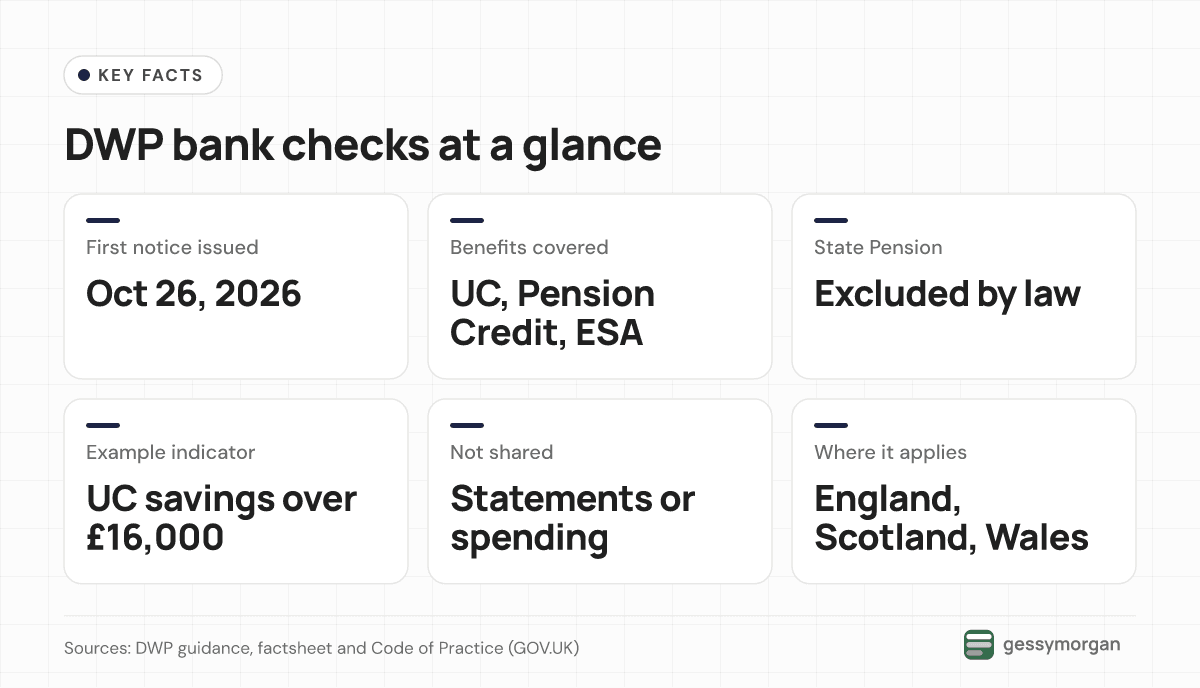
The DWP bank checks on benefit eligibility began on October 26, 2026, when the Department for Work and Pensions issued its first Eligibility Verification Notice to banks. Banks now screen accounts that receive Universal Credit, Pension Credit or New Style Employment and Support Allowance (ESA) for signs that a payment may be wrong, such as savings above a limit, and flag matching accounts to DWP. They do not hand over statements or spending details, and the State Pension is excluded.
For most claimants there is nothing to do. As of October 31, 2026, the checks are in a controlled test phase with a small number of banks. This is general information, not advice; the official source is DWP's guidance on GOV.UK.
What started on October 26
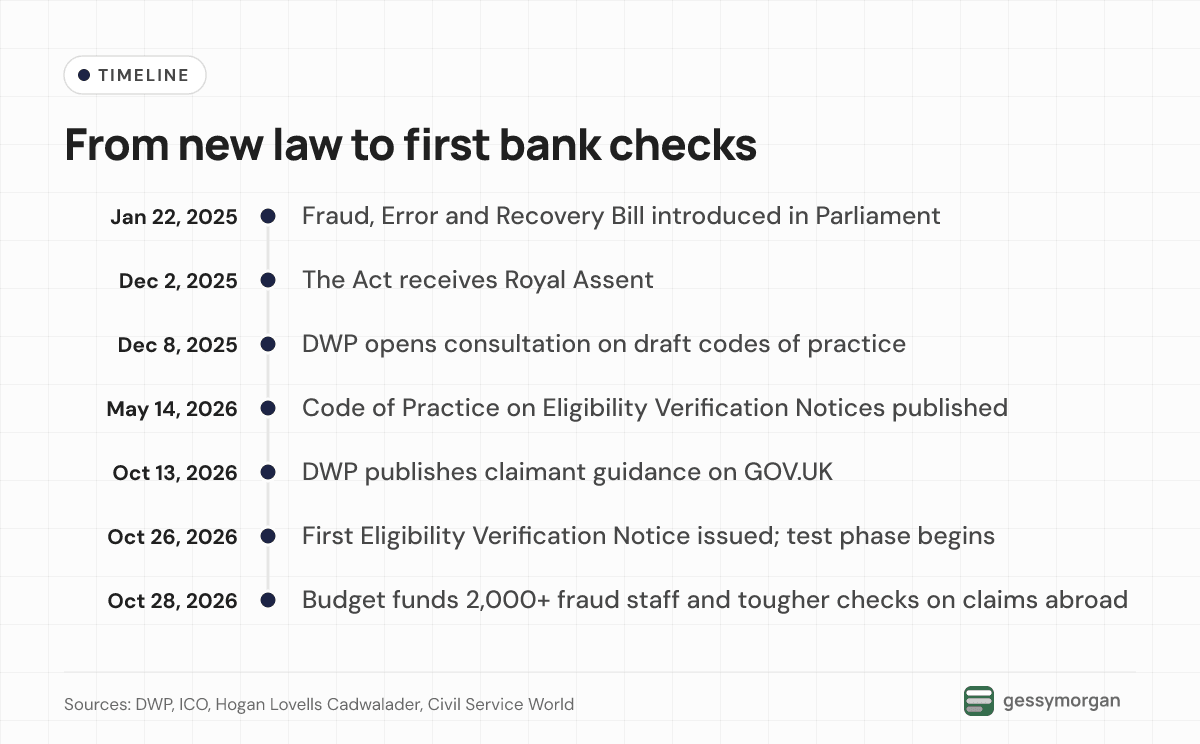
The power comes from the Public Authorities (Fraud, Error and Recovery) Act 2025. The bill was introduced in January 2025 and received Royal Assent on December 2, 2025, according to law firm Hogan Lovells Cadwalader. DWP published a statutory Code of Practice on Eligibility Verification Notices on May 14, 2026, and its claimant guidance on October 13.
In a written statement to Parliament, DWP minister Lilian Greenwood said implementation would begin "through a controlled test-and-learn phase", Benefits and Work reported. The Code says that first phase involves "a small number of financial institutions".
No participating banks have been named, as Public Sector Executive and the Daily Gazette noted. Which? reported that DWP is working with the 15 largest UK banks; we could not confirm that officially.
How DWP bank checks on benefit eligibility work
DWP does not look into accounts itself. A notice tells each bank which "eligibility indicators" to look for, and the bank checks the data it already holds on accounts that receive a specified DWP benefit.
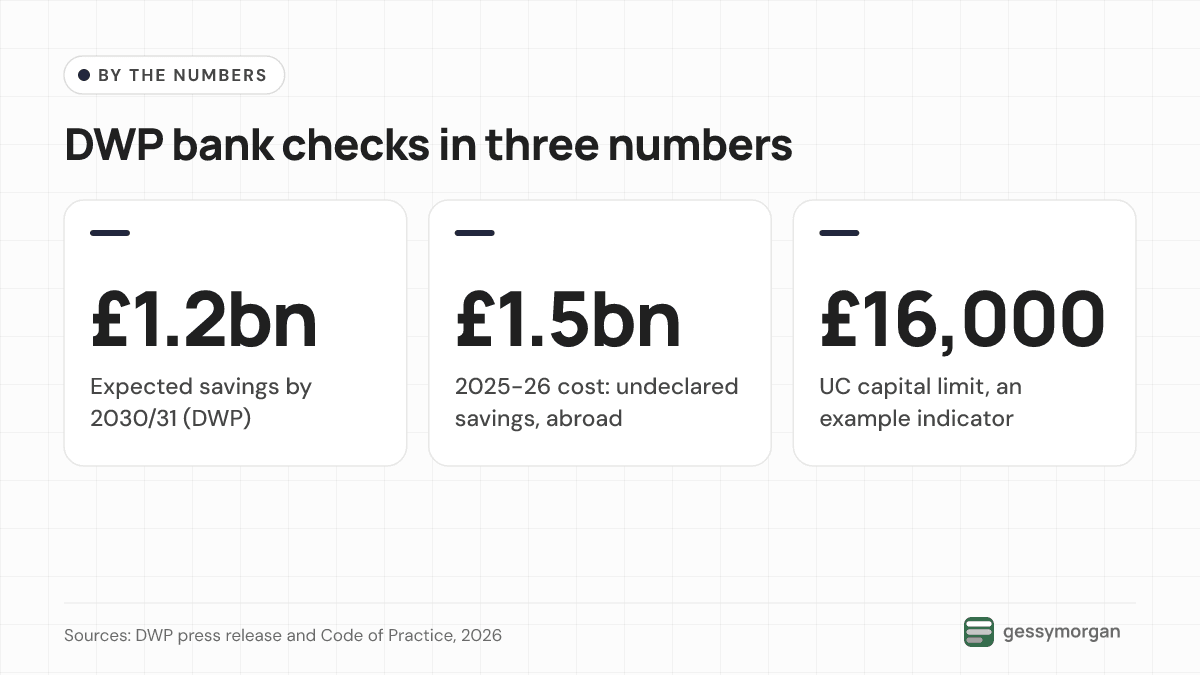
DWP will not publish the exact indicators, saying that could help fraudsters get around them. The Code gives examples: a Universal Credit account holding more than £16,000, the benefit's upper capital limit, or signs that someone has spent more time abroad than the rules allow.
The Code also says a notice "cannot be used, in any circumstances, to require information about named claimants".
DWP matches returned data to its own records and aims to act promptly, for example within a month. A flag is not proof and triggers no automatic suspension; DWP says "any decision about your benefit entitlement or payments will always be made by DWP staff".
What banks will check, and what they will not
When an account meets an indicator, the GOV.UK guidance says a bank may share:
- the names of all account holders (the Code adds dates of birth)
- details of the accounts held, including linked and joint accounts
- account numbers and sort codes
- how much money is in the relevant accounts
- dates of transactions made in another country
Banks cannot share:
- full statements or individual transactions
- how you spend your money, or exactly where a transaction took place
- sensitive details such as religious beliefs or political opinions
- information more than a year old, with limited exceptions (per the Code)
The guidance says: "DWP cannot log into your online banking or see your account in real time." Banks can be fined for sharing too much. According to the Code, credit cards, current account mortgages, business accounts and accounts held outside the UK are out of scope.
Greenwood said: "We are not interested in where people do their weekly shop or how much they're spending on new clothes."
Which benefits are in scope, and why the State Pension is not
Three benefits are covered: Universal Credit, Pension Credit and New Style ESA, in England, Scotland and Wales, as the Daily Record also reported. The Code says "no other benefits are currently in scope". Adding any would need regulations approved by Parliament.
DWP's factsheet on the law states: "The State Pension is explicitly excluded from the power and cannot be added by regulations." If you also get Pension Credit, though, the account it is paid into can be checked because of the Pension Credit.
Personal Independence Payment (PIP) is not in scope, but Benefits and Work notes that an account receiving both PIP and Universal Credit can be checked because of the Universal Credit.
The guidance says a flagged account "may belong to either a claimant or a non-claimant". Where a benefit is paid into a joint account, the Code says details about accounts held by both people can be shared. If the account belongs to an appointee or landlord who is not the claimant, the data is destroyed unless that person also claims a covered benefit.
What claimants need to do
Usually nothing. Nothing in the official guidance asks claimants to contact their bank, register or send documents for these checks, and DWP will not tell you each time a bank shares data about you.
The guidance does ask you to report changes promptly, including:
- savings, investments or income
- your address, or who lives with you
- one-off payments such as gifts, refunds or compensation
- time spent outside England, Scotland and Wales, including holidays
If DWP needs to check your claim, it will contact you through your online journal, or by phone, letter or text, and may ask for evidence. Replying quickly helps avoid payments being delayed or stopped. If you disagree with a decision, you can ask for a mandatory reconsideration, and you can make a subject access request to see what DWP holds about you.
DWP's helplines are 0800 328 5644 for Universal Credit, 0800 731 0469 for the Pension Service and 0800 169 0310 for Jobcentre Plus (New Style ESA).
Scam warnings
Fraudsters exploit headlines like these. The Northern Ireland government's nidirect site says the UK Government and DWP "will never ask for your bank details by text, email or via links to click within a text or email".
- Do not click links or reply to messages asking you to "verify" your bank account for DWP.
- Find phone numbers yourself on GOV.UK rather than using one given in a message.
- Forward suspicious emails to report@phishing.gov.uk and texts to 7726, as GOV.UK advises.
- If you have lost money in England or Wales, contact Report Fraud on 0300 123 2040. In Scotland, report it to Police Scotland.
The savings figures and the criticism
DWP estimates that fraud and error linked to undeclared savings and time abroad in Universal Credit and Pension Credit cost £1.5 billion in 2025-26, and puts the overall fraud and error rate at 3.2%. It expects the checks to save £1.2 billion by 2030/31.
Earlier estimates differed: DWP's factsheet forecast up to £940 million over five years, while Which? cites £1.5 billion by 2030.
The Information Commissioner said the Bill's safeguards had "mitigated some concerns", but that it is for government to decide whether the measure is "necessary, proportionate and fair". Benefits and Work set the "crackdown" framing against estimates that up to £12.7 billion of Universal Credit went unclaimed in the year to March 2025.
How this fits with the Budget and other bank powers
The October 28 Budget added more anti-fraud measures. Civil Service World reported that DWP will be funded to hire over 2,000 specialist staff to prevent fraud in Universal Credit claims, alongside stronger checks on claimants abroad and more checks on capital in Pension Credit. Chancellor John Healey said the package should save a further £1.4 billion. Our UK Budget 2026 explainer has the wider picture.
Two other powers are easily confused with the checks. Under the same Act, DWP can recover some benefit debts from bank accounts through Direct Deduction Orders, with at least a month to object, according to Which?. Separately, HMRC will be able to take tax debts of up to £5,000 for individuals from bank accounts from 2029/30, ICAEW reported.
What to watch next
- Wider rollout: the Code says the measure will expand "in a controlled way" after the test phase.
- Independent reviewer: the Act requires an annual review that must be laid before Parliament. DWP said in May 2026 that recruitment would launch "in due course".
- New benefits: extending the checks beyond the three benefits would need a vote in Parliament.
Our take
Based on the official documents, the checks are narrower than some headlines suggest, but claimants are not told when their data is shared, so keeping DWP updated about savings and time abroad is the simplest protection.
Frequently asked questions
Can the DWP see my bank transactions?
No. Under the Eligibility Verification Measure, banks cannot share statements, individual transactions or details of how you spend your money, and DWP cannot log into your online banking. Banks share limited details, such as names, account numbers, balances and dates of overseas transactions, only when an account meets an eligibility indicator.
Do the DWP bank checks apply to the State Pension?
No. DWP says the State Pension is explicitly excluded from the power and cannot be added by regulations. If you also receive Pension Credit, the account it is paid into can be checked because Pension Credit is covered.
Which benefits are affected by the DWP bank checks?
Universal Credit, Pension Credit and New Style Employment and Support Allowance, in England, Scotland and Wales. No other benefits are currently in scope, and adding any would need regulations approved by Parliament.
Do I need to do anything about the DWP bank checks?
Usually not. Keep DWP updated about changes such as savings, income, who lives with you and time abroad, and reply quickly if DWP contacts you. Be wary of any text or email asking for your bank details; official advice says DWP never requests them that way.
When did the DWP bank checks start?
DWP issued its first Eligibility Verification Notice on October 26, 2026. As of October 31, 2026, the checks are in a test phase with a small number of banks, and DWP has not given a date for the wider rollout.
Sources
- How DWP checks benefit eligibility using the Eligibility Verification Measure, Department for Work and Pensions (GOV.UK)
- Government unleashes £1.2 billion crackdown as part of anti-fraud drive, Department for Work and Pensions (GOV.UK)
- DWP's eligibility verification powers in the Public Authorities (Fraud, Error and Recovery) Bill: factsheet, Department for Work and Pensions (GOV.UK)
- Code of Practice on Eligibility Verification Notices, Department for Work and Pensions (GOV.UK)
- Government response to the Public Authorities (Fraud, Error and Recovery) Act DWP Codes of Practice consultation, Department for Work and Pensions (GOV.UK)
- Avoid and report internet scams and phishing, GOV.UK
- Online and text scams, nidirect
- Eligibility Verification Measure in the Public Authorities Bill: Information Commissioner's response, Information Commissioner's Office
- Can the DWP really check your bank account?, Which?
- DWP bank account checks: what will banks disclose and will you be told?, Benefits and Work
- First DWP bank account checks underway as "£1.2 billion crackdown" begins, Benefits and Work
- DWP issues first Eligibility Verification Notice to banks in major anti-fraud drive, Public Sector Executive
- DWP starts new bank account checks for people on three benefits, Daily Record (via Yahoo Life UK)
- Government DWP bank checks begin for people claiming three benefits, Daily Gazette
- Department of Work and Pensions to recruit 2,000 specialist fraud staff, Civil Service World
- Banks and EMIs face detailed new information and account direct deduction obligations as UK Public Authorities (Fraud, Error and Recovery) Act 2025 receives Royal Assent, Hogan Lovells Cadwalader
- Budget: government confirms measures to tackle tax debt, ICAEW
How we wrote this
GessyMorgan explainers are built from public reporting and official sources. This post draws on the 17 sources listed above, each linked where we use it. It was drafted with AI assistance and checked against those sources before publishing. We did not test products, attend events or interview anyone for this article. Facts are current as of October 31, 2026, and we update the post when they change.