Nationwide UK Property Price Drop: October 2026 Explained
Nationwide says UK house prices were flat in October 2026 and annual growth slowed to 0.5%, the weakest since January 2024. Here is what the figures show, how other indices compare and what to watch next.
- Nationwide's October 2026 index, out October 30, shows UK prices flat on the month and up just 0.5% on a year, the weakest growth since January 2024.
- The drop is in the unadjusted average, down £685 to £273,566 and about 1.9% below April's £278,880, as mortgage rates near 6% squeeze buyers.
- Next up is the Bank of England's November 5 decision, where a rise from 3.75% to 4% is widely expected. General information, not financial advice.
Nationwide's October 2026 House Price Index, published on Friday, October 30, shows UK house prices were flat in October after seasonal adjustment, while annual growth slowed to 0.5%, the weakest since January 2024. The "Nationwide UK property price drop" in the headlines is in the raw average price, which fell £685 in a month to £273,566 and is now about 1.9% below April's £278,880, according to Nationwide's monthly figures.
This guide covers the October numbers, what Nationwide's chief economist said, how other house price measures compare, and the Budget and Bank of England backdrop. It is accurate as of October 31, 2026, and is general information only, not financial advice.
Nationwide UK property price drop: the October numbers
The Nationwide release gives these headline figures for October 2026:
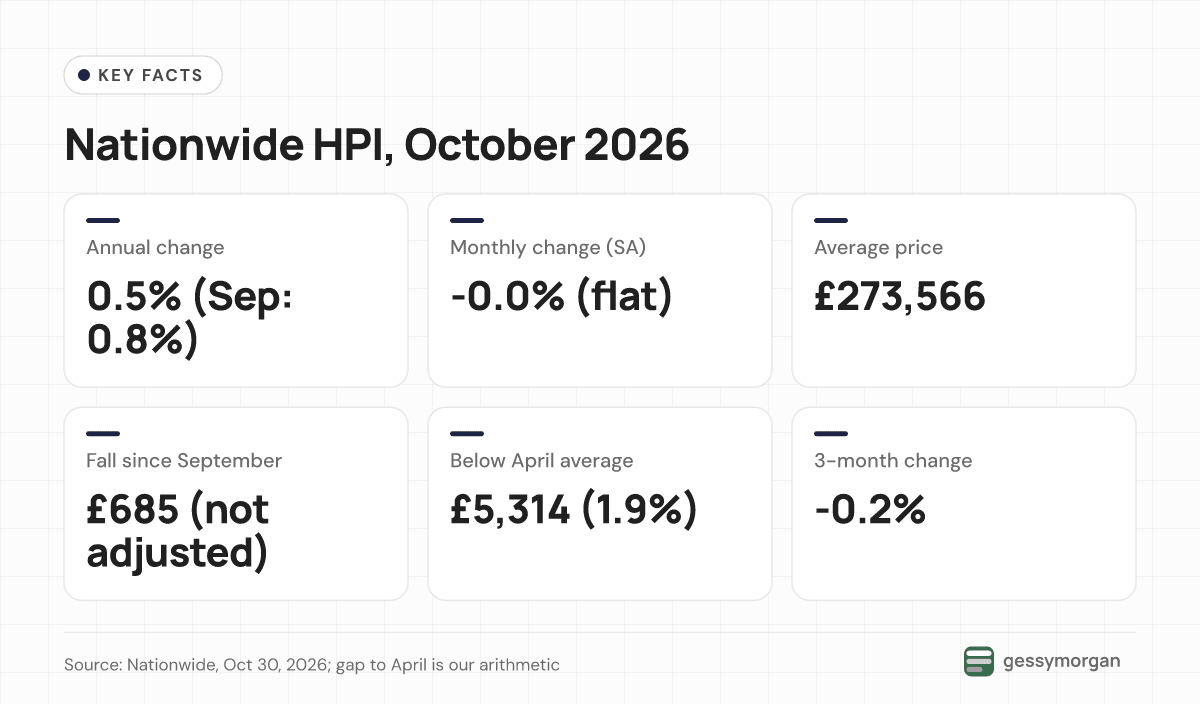
- Monthly change: -0.0% (seasonally adjusted), after -0.3% in September
- Annual change: 0.5%, down from 0.8% in September
- Three months on the previous three: -0.2%, after -0.4%
- Average price (not seasonally adjusted): £273,566, down from £274,251
A reading of -0.0% is a fall too small to show at one decimal place, so Nationwide calls prices unchanged. The £685 fall in the average is not seasonally adjusted, so some of it may be normal for the time of year.
Nationwide also revises recent months when it re-estimates seasonal factors. Its September release first put that month's fall at 0.2%; the October table now shows 0.3%.
Six months of stalling since April
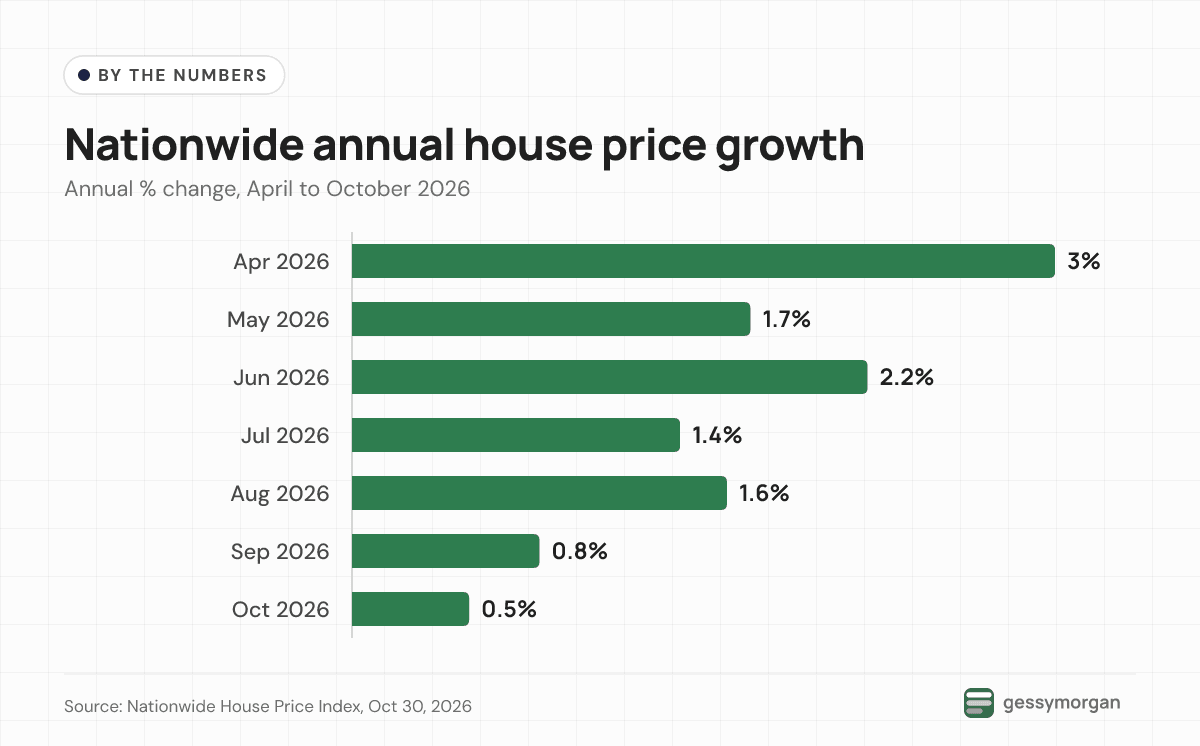
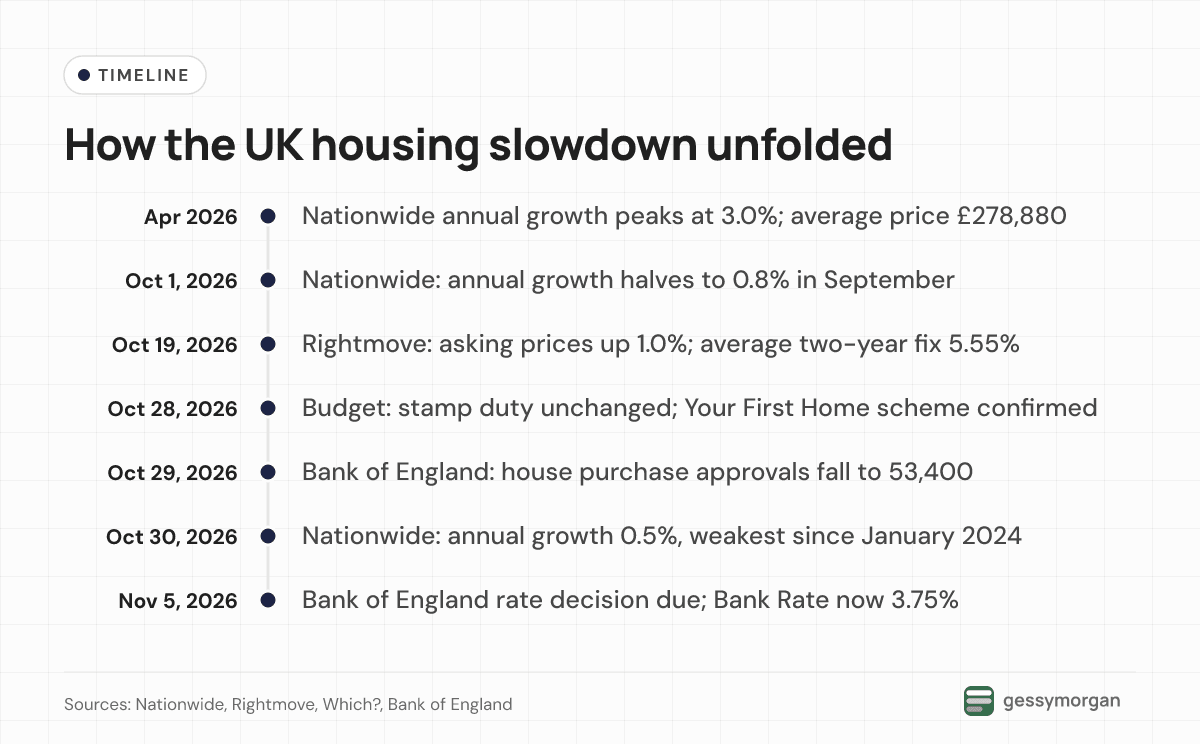
Annual growth reached 3.0% in April, when the average price hit £278,880, Nationwide's table shows. It has slowed in most months since, to 1.7% in May, 1.4% in July, 0.8% in September and 0.5% in October. Investing.com described prices as having stalled for six months.
What Nationwide's chief economist said
Robert Gardner, Nationwide's chief economist, said: "That is the weakest growth since January 2024." He linked the slowdown to an uncertain economic backdrop. The Middle East conflict is pushing up energy prices and inflation worries, he said, which has led financial markets to expect Bank Rate increases and kept mortgage pricing high.
His near-term view was cautious: "Forward-looking indicators suggest further softness in the near term." He said surveyors report weak new buyer enquiries, and that consumer sentiment dipped noticeably in October.
He also expects a later recovery: "Once the energy shock fades, there are good reasons to believe the market will regain momentum." He cited steady jobs and real incomes, household debt near 20-year lows relative to income, and incomes outpacing house prices.
How Nationwide compares with Lloyds (Halifax), ONS and Rightmove
The main indices measure different stages of a sale, so they rarely match. Nationwide uses its own mortgage approvals, its report notes. Rightmove tracks asking prices of new listings, and the official ONS figures use completed sales, which lag, as BCIS points out.
- Lloyds (formerly Halifax): the Halifax index was renamed the Lloyds House Price Index in July 2026, with the same method, BCIS reports. September prices were flat on the month and on the year, at an average of £298,441, Trading Economics reports. October's figures are due in early November.
- ONS: the official UK figures published on October 21 put the average at £273,000 in August, up 0.9% on a year earlier. Among English regions, London was weakest, down 2.2%, and the North East strongest, up 3.2%. The next release is on November 18.
- Rightmove: average asking prices rose 1.0% in October to £371,015 but were 0.1% lower than a year earlier, according to Rightmove's October 19 report. Sales agreed were 8% below a year ago, and the number of homes for sale was the highest for the time of year since 2014.
The regional picture
Nationwide's October report has no regional breakdown, because regional data comes once a quarter. Its third-quarter figures, published with the September index, showed Northern Ireland strongest at 5.9% annual growth and East Anglia weakest at -0.7%, with London up 0.4%. Northern England rose 1.6% while southern England slipped 0.1%. Terraced homes rose 1.8%, while flats were roughly flat on the year.
Why prices are stalling: mortgage rates and the Bank of England
Borrowing has become much more expensive this year. Moneyfacts' average two-year fix was 5.97% and its five-year fix 6.00% on October 30, Mortgage Strategy reports. Rightmove's tracker, which uses different data, put the two-year average at 5.55% on October 19, up from 4.25% before the war in Iran began in February. Rightmove says that adds about £250 a month to a typical new mortgage.
Rightmove's Colleen Babcock said: "The rapid rise in mortgage rates is really beginning to hit buyers' budgets."
Demand figures point the same way. Mortgage approvals for house purchase fell to 53,400 in September, the Bank of England said on October 29, compared with 65,900 a year earlier. That is about 19% fewer, by our arithmetic. Remortgaging approvals rose to 42,600 from 34,000. Richard Pinch of Broadstone told Today's Conveyancer the market is "under increasing pressure".
Bank Rate is 3.75%, and the next decision is due on November 5, according to the Bank of England. With inflation at 3.5% in September, a rise to 4% is widely expected, The Telegraph reports, though nothing is confirmed. Moneyfacts' Adam French said "the market is taking stock ahead of a likely base rate rise next week". Our Bank of England November 2026 guide explains what a change could mean for mortgages and savings.
What the Budget changed for home buyers
The October 28 Budget left stamp duty unchanged, Which? reports. In England and Northern Ireland, first-time buyers still pay nothing on the first £300,000 of a home worth up to £500,000, according to GOV.UK. The main housing measures, as Which? summarises them:
- Your First Home: a 20% government equity loan for first-time buyers of new-build homes in England, with deposits of 2.5% to 15%, no interest for five years, and household income caps of £110,000 (£140,000 in London). Pre-registration opens by the end of December, full applications in February 2027, and first loans are expected from April 2027.
- Landlords: income tax on property income rises to 24%, 44% and 49% from April 2027.
- High-value homes: the council tax surcharge on homes in England worth over £2 million still starts in April 2028.
Not everyone expects this to lift prices soon. Ashley Webb of Capital Economics said the Budget is "only offering limited support to housing activity from next April", and added, "we suspect house prices will continue to fall in the coming months", The Telegraph reports. That is a forecast, not a certainty. North London estate agent Jeremy Leaf said buyers and sellers who paused before the Budget "are slowly resuming activity, albeit cautiously". Our UK Budget 2026 guide covers the wider measures.
What it means for buyers and sellers
- Buyers: flat prices and plenty of homes for sale may give more room to negotiate, but higher mortgage rates reduce how much you can borrow. Look at the total monthly cost, not just the price.
- Sellers: Rightmove's data suggests pricing realistically from the start matters. In London, 38% of listings have had a price cut and homes take 78 days on average to find a buyer.
- Homeowners with a fixed deal ending: any new deal will be priced at today's rates, so compare them with what you pay now.
This is general information, not financial advice. For your own situation, speak to a regulated mortgage adviser, and use HMRC's stamp duty calculator, linked from GOV.UK.
Key dates to watch
- November 5: Bank of England interest rate decision
- Early November: Lloyds House Price Index for October (September's came out on October 7)
- November 18: ONS house price and rent figures
- Around the start of December (expected): Nationwide's November index. Its index page lists no future dates; the last two reports came out on October 1 and October 30.
- By the end of December: Your First Home pre-registration opens
Our take
Based on these sources, "drop" overstates October on its own: seasonally adjusted prices held steady, and the fall is in the raw average and the gap to April's high. The direction is still soft, with slowing growth, fewer approvals and fixed rates near 6%.
Much depends on the Bank of England on November 5 and on energy prices. Nationwide expects a recovery once the energy shock fades; Capital Economics expects further falls first. Both are forecasts.
Frequently asked questions
Did UK house prices fall in October 2026, according to Nationwide?
Only marginally. Nationwide's seasonally adjusted index was unchanged on the month (-0.0%), and annual growth slowed to 0.5%, the weakest since January 2024. The unadjusted average price fell £685 to £273,566 and is about 1.9% below April's £278,880.
What is the average UK house price now?
Nationwide put it at £273,566 in October 2026. Other measures differ because they cover different stages of a sale: the ONS average was £273,000 in August, the Lloyds (formerly Halifax) average was £298,441 in September, and Rightmove's average asking price was £371,015 in October.
Why are UK house prices stalling?
Nationwide links it to economic uncertainty and higher energy prices from the Middle East conflict, which have raised expectations of Bank Rate increases and kept mortgage rates high. Moneyfacts' average two-year fix was 5.97% on October 30, and mortgage approvals for house purchase fell to 53,400 in September, Bank of England data show.
When is the next Nationwide house price index?
Nationwide's house price index page lists no future dates. Its last two monthly reports came out on October 1 and October 30, so the November figures are expected around the start of December. Regional figures are published once a quarter.
Will UK house prices fall further?
Forecasts differ. Capital Economics expects prices to keep falling in the coming months, while Nationwide expects further softness in the near term but a recovery once the energy shock fades. Neither is certain, and this is general information, not financial advice.
Sources
- Annual house price growth slows again in October, Nationwide Building Society
- House Price Index, October 2026 (PDF), Nationwide Building Society
- Annual house price growth halves in September, Nationwide Building Society
- Nationwide House Price Index, Nationwide Building Society
- UK house prices flat in October as rate rise bets weigh, Nationwide says, Investing.com
- House prices rise at slowest pace in nearly three years, The Telegraph (via Yahoo Finance)
- House Price Index, 19 October 2026 (PDF), Rightmove
- Private rent and house prices, UK: October 2026, Office for National Statistics
- Money and Credit - September 2026, Bank of England
- Money and Credit - September 2025, Bank of England
- Interest rates and Bank Rate, Bank of England
- UK House Prices Stagnate in September, Trading Economics
- The latest analysis of movement in house price indices, BCIS
- Average fixed rates stay steady this week, says Moneyfacts, Mortgage Strategy
- Autumn Budget 2026: boost for first-time buyers, but landlords hit again, Which?
- Stamp Duty Land Tax, GOV.UK
- Residential mortgage approvals dropped to 53,400 in September, Today's Conveyancer
How we wrote this
GessyMorgan explainers are built from public reporting and official sources. This post draws on the 17 sources listed above, each linked where we use it. It was drafted with AI assistance and checked against those sources before publishing. We did not test products, attend events or interview anyone for this article. Facts are current as of October 31, 2026, and we update the post when they change.