DA Hike News: Cabinet Approves 3% Rise to 63% From July 2026
The Union Cabinet approved a 3-point DA and DR hike to 63% on October 28, 2026, backdated to July 1. Here is who benefits, how arrears work and where the 8th Pay Commission stands.
- On October 28, 2026, the Cabinet raised DA for central government employees and DR for pensioners from 60% to 63%, effective July 1, 2026.
- About 48.54 lakh employees and 68.71 lakh pensioners benefit; the annual cost is ₹10,016.10 crore, and arrears are due from July.
- The 8th Pay Commission has not reported yet; its 18-month deadline falls around May 2027 and no effective date has been fixed.
The DA hike is confirmed. On October 28, 2026, the Union Cabinet approved a 3 percentage point rise in Dearness Allowance (DA) for central government employees and Dearness Relief (DR) for pensioners, taking both from 60% to 63% of basic pay or pension. The new rate applies from July 1, 2026, so arrears are due for the months already paid at the old rate, according to the Press Information Bureau (PIB).
This guide pulls together the latest DA news: who benefits, how the rise was calculated, simple worked examples, what is known about arrears, and where the 8th Pay Commission stands. It is general information, not financial advice, and it is current as of October 28, 2026.
DA hike news: what the Cabinet approved
The Cabinet, chaired by Prime Minister Narendra Modi, approved an additional instalment of DA and DR at its Wednesday meeting. The official release, posted at 3:50pm IST, says the increase is meant "to compensate against price rise" and follows the accepted formula based on the 7th Central Pay Commission's recommendations.
Information and Broadcasting Minister Ashwini Vaishnaw announced the decision and said it came ahead of Diwali, PTI reported via OrissaPOST. (Our Diwali 2026 guide has the festival dates.) Deccan Chronicle and the Free Press Journal reported the same move from 60% to 63%.
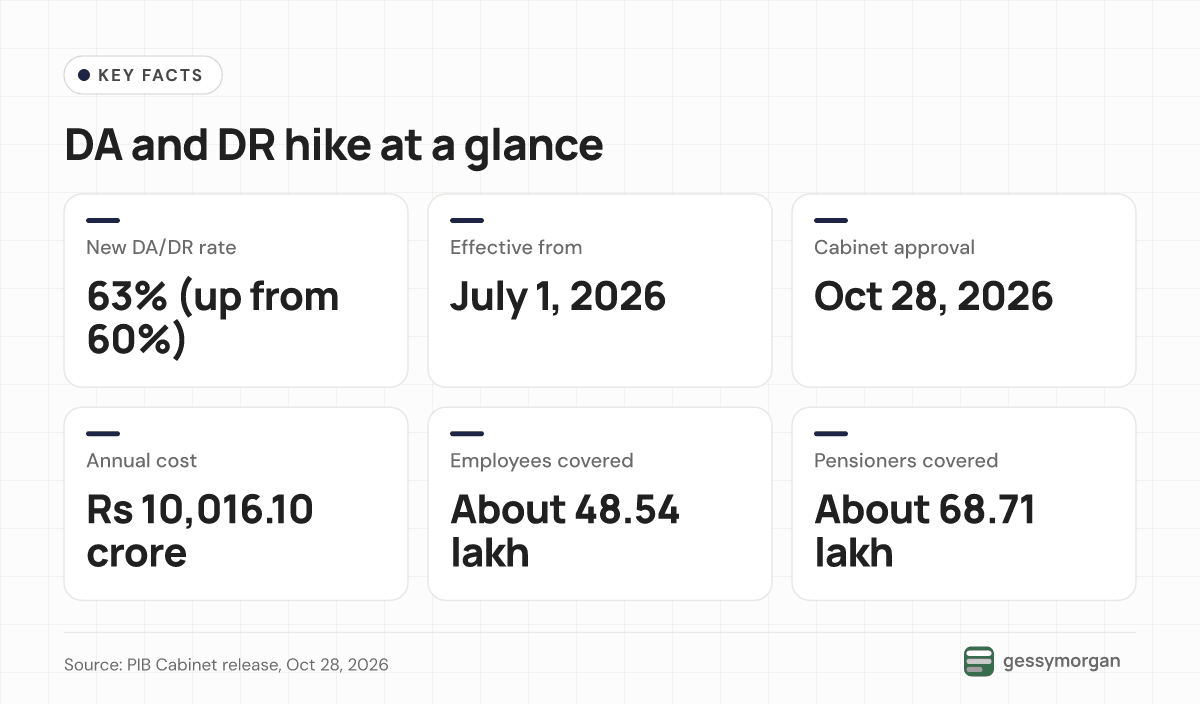
The key numbers from the PIB release:
- New rate: 63% of basic pay (DA) and basic pension (DR), up from 60%.
- Effective date: July 1, 2026.
- Cost: ₹10,016.10 crore a year for DA and DR combined.
- Who benefits: about 48.54 lakh central government employees and 68.71 lakh pensioners, or roughly 1.17 crore people in total.
Business Today rounded these to ₹10,016 crore, about 48 lakh employees and 68 lakh pensioners. It also reported matching rises for people still on older pay scales: from 262% to 269% under 6th Pay Commission scales, and from 483% to 497% under 5th Pay Commission scales, both from July 1.
Who gets the DA and DR hike
The decision covers central government employees on the 7th Pay Commission pay matrix and central government pensioners. Serving staff receive the rise as DA on basic pay. Pensioners receive it as DR on basic pension.
Some groups get their own implementing orders. When the Finance Ministry notified the previous rise, its office memorandum of April 22, 2026 said the order also covered civilian staff paid from defence budgets. Armed Forces personnel and Railway employees were to get separate orders from the Defence and Railways ministries.
This Cabinet decision is for the Centre's own employees and pensioners. State government staff should look for their own state's DA order. Separately, Business Today reported that the Department of Public Enterprises revised Industrial DA for some central public sector executives from October 1, 2026, which is a different scheme.
How the 3% figure was worked out
DA is revised twice a year, for January and July, to offset rising prices. The rate follows the 12-month average of the All-India Consumer Price Index for Industrial Workers (CPI-IW), the Free Press Journal explained.
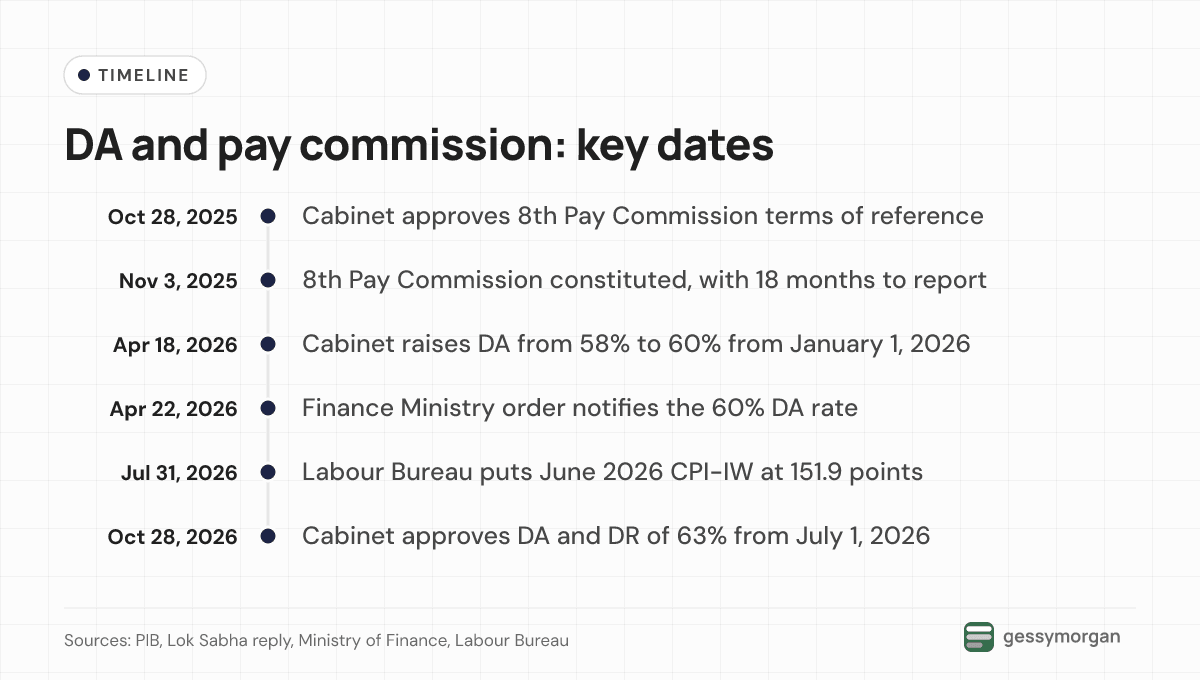
The final input for the July rate arrived on July 31, 2026. That day the Labour Bureau put the June 2026 CPI-IW at 151.9 points, up 1.1 points from May, with year-on-year inflation of 4.76%. Using that series, StaffNews calculated an unrounded 7th Pay Commission DA of 63.75%, which becomes 63% once the decimal is dropped. That is why employee groups expected a 3-point rise months before the Cabinet met.
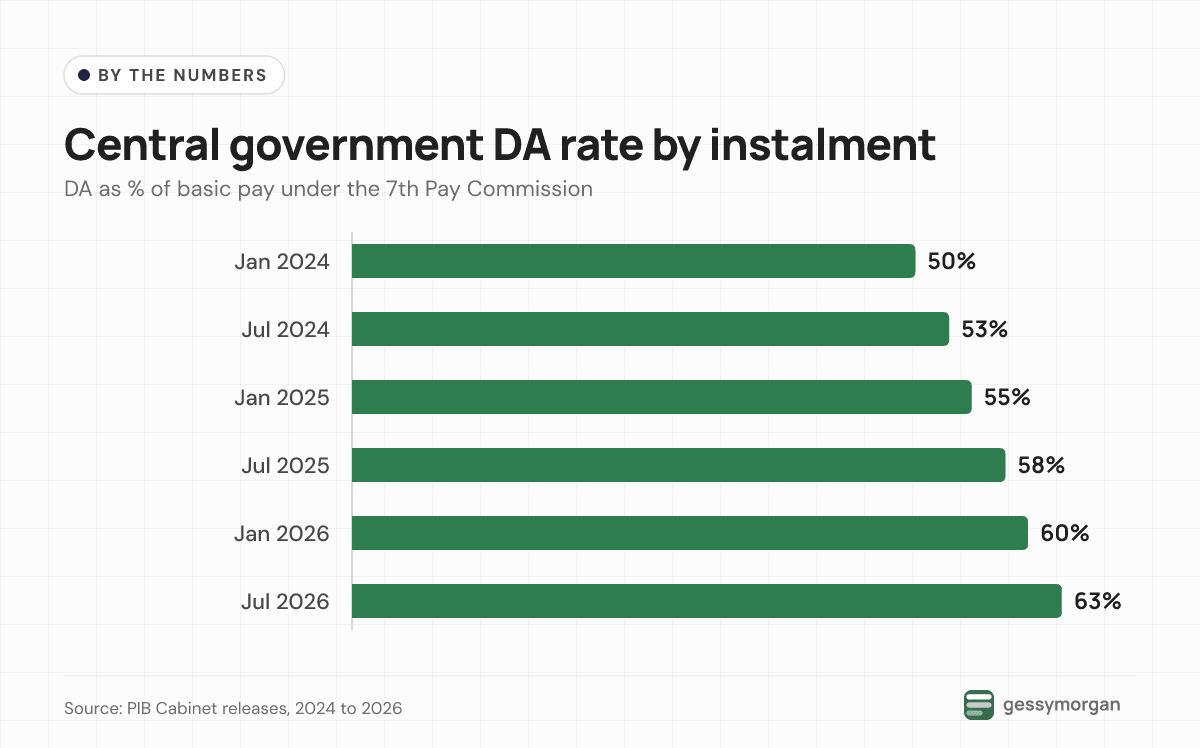
The approval came later than in recent years. The July instalment was cleared on October 16 in 2024 and on October 1 in 2025. Over the same period DA has climbed steadily: 50% from January 2024, 53% from July 2024, 55% from January 2025, 58% from July 2025, 60% from January 2026 and now 63%.
How much more you get: worked examples
The examples below are illustrations only, using round numbers. They show DA or DR on basic pay or pension alone. Your actual payslip also depends on other allowances, deductions and income tax.
The method is simple: multiply your basic pay or basic pension by 3% to find the monthly increase.
- Basic pay of ₹18,000: DA rises from ₹10,800 (60%) to ₹11,340 (63%), an extra ₹540 a month. The Free Press Journal used the same example.
- Basic pay of ₹50,000: DA rises from ₹30,000 to ₹31,500, an extra ₹1,500 a month.
- Basic pension of ₹20,000: DR rises from ₹12,000 to ₹12,600, an extra ₹600 a month.
How arrears work
Because the new rate dates back to July 1, the 3% difference for each month already paid at 60% is owed as arrears. As an illustration, if the higher rate first appears in November's pay, the arrears would cover four months, July to October:
- ₹540 × 4 = ₹2,160 on a basic pay of ₹18,000.
- ₹1,500 × 4 = ₹6,000 on a basic pay of ₹50,000.
- ₹600 × 4 = ₹2,400 on a basic pension of ₹20,000.
The real number of months depends on when your office applies the order. The April 2026 Finance Ministry order also said DA amounts of 50 paise or more are rounded up to the next rupee, and smaller fractions are ignored.
When will the money arrive?
As of October 28, 2026, the Cabinet release gives no payment date. The new rate is put into effect through an office memorandum from the Finance Ministry's Department of Expenditure, after which ministries and pay offices process it.
Past cycles suggest the order tends to follow within days. The January 2026 rise was approved on April 18 and notified on April 22. That order also referred to an earlier memorandum dated October 6, 2025, five days after the Cabinet's October 1, 2025 approval. No official payment month has been announced for this rise, so treat any specific date shared on social media as unconfirmed and check your department's circular or your pension disbursing bank.
8th Pay Commission status
This DA hike is still calculated under the 7th Pay Commission formula because the 8th Central Pay Commission has not yet reported. The Cabinet approved its terms of reference on October 28, 2025, giving it 18 months from its constitution to make recommendations, with the option of interim reports.
The commission was set up on November 3, 2025. It is chaired by Justice Ranjana Prakash Desai, with Prof. Pulak Ghosh as part-time member and Pankaj Jain as member-secretary, according to a Lok Sabha reply of August 10, 2026 by Minister of State for Finance Pankaj Chaudhary. That reply said the commission had not yet submitted its recommendations, and that the effective date would be decided only after the report is received and examined.
That puts the report deadline around May 2027, The Hans India reported. PIB's 2025 release noted that, going by the ten-year trend, the commission's effect "would normally be expected from 01.01.2026". The government has not confirmed that date.
The commission has been meeting staff associations and pensioner groups around the country. It was scheduled to hold meetings in Mumbai on October 22 and 23, The Sunday Guardian reported, adding that no fitment factor has been announced. Fitment factors circulating online, including union demands, are proposals, not decisions.
Key dates and how to follow DA news
- Coming days: watch for the Department of Expenditure order on the 63% rate, then the orders for pensioners, Railways and the Armed Forces.
- Next payday: check your payslip or pension credit for the new rate and a separate arrears entry.
- January 2027 instalment: if the usual pattern holds, it will be based on CPI-IW data through December 2026, which the Labour Bureau publishes monthly.
- Around May 2027: the 8th Pay Commission's 18-month deadline.
For official updates, rely on PIB releases, Finance Ministry orders and your own department or pension office rather than forwarded messages.
Our take
Based on the sources above, this is a routine, formula-driven revision rather than a policy shift. The inflation data had pointed to 63% since the end of July. What stood out was the timing: approval came about four weeks later than last year, which makes the arrears period longer.
The bigger question for central staff and pensioners is the 8th Pay Commission, whose recommendations, not DA instalments, will reset basic pay. Until it reports and the government decides, DA is likely to keep moving in half-yearly steps under the existing formula.
Frequently asked questions
What is the new DA rate for central government employees?
DA is now 63% of basic pay, up from 60%, with effect from July 1, 2026. The Union Cabinet approved it on October 28, 2026. Pensioners get the same rise as Dearness Relief, also 63% of basic pension.
When will the DA arrears be paid?
As of October 28, 2026, no payment date has been announced. Arrears are due from July 1, 2026, and are paid once the Finance Ministry issues its order and departments process it. For the January 2026 rise, the order came four days after Cabinet approval.
How much will my salary go up after the 3% DA hike?
Monthly DA rises by 3% of your basic pay. As an illustration, a basic pay of ₹18,000 gets ₹540 more a month and ₹50,000 gets ₹1,500 more. Your actual take-home depends on other allowances, deductions and tax.
Has the 8th Pay Commission been implemented?
No. The 8th Central Pay Commission was constituted on November 3, 2025, and has 18 months to report, which points to around May 2027. The government says the effective date will be decided after it receives and examines the report.
Does this DA hike apply to state government employees?
No. The October 28 decision covers central government employees and pensioners. State government staff should check for an order from their own state government.
Sources
- Cabinet approves Dearness Allowance to Central Government employees and Dearness Relief to Pensioners (Oct 28, 2026), Press Information Bureau
- Cabinet approves additional instalment of DA and DR w.e.f. 01.01.2026 (Apr 18, 2026), Press Information Bureau
- Cabinet approves additional instalment of three per cent DA and DR (Oct 1, 2025), Press Information Bureau
- Cabinet approves additional instalment of DA and DR w.e.f. 01.01.2025 (Mar 28, 2025), Press Information Bureau
- Cabinet approves additional instalment of three percent DA and DR (Oct 16, 2024), Press Information Bureau
- Cabinet approves additional instalment of DA and DR w.e.f. 1.1.2024 (Mar 7, 2024), Press Information Bureau
- Cabinet approves Terms of Reference of 8th Central Pay Commission (Oct 28, 2025), Press Information Bureau
- Consumer Price Index for Industrial Workers (2016=100) – June, 2026, Labour Bureau, Ministry of Labour & Employment
- Revision of rates of Dearness Allowance effective from 01.01.2026 (OM dated Apr 22, 2026, DAE endorsement), Ministry of Finance, Department of Expenditure
- Diwali gift: Cabinet approves 3% DA hike for central government employees, pensioners, Business Today
- Centre Hikes DA By 3% To 63% For Central Govt Employees, Pensioners Ahead Of Diwali, Free Press Journal
- Cabinet approves 3% hike in dearness allowance for central govt employees, OrissaPOST (PTI)
- Centre Announces 3% DA Hike For Central Govt Employees, Pensioners, Deccan Chronicle
- Central government clarifies status of 8th Pay Commission report deadline, The Hans India
- 8th Central Pay Commission: Government Provides Key Details in Lok Sabha, Postalstudy
- DA/DR from July 2026 @ 63% confirmed (CPI-IW for June 2026), StaffNews
- 8th Pay Commission Latest News: Mumbai Meetings on October 22–23, The Sunday Guardian
How we wrote this
GessyMorgan explainers are built from public reporting and official sources. This post draws on the 17 sources listed above, each linked where we use it. It was drafted with AI assistance and checked against those sources before publishing. We did not test products, attend events or interview anyone for this article. Facts are current as of October 28, 2026, and we update the post when they change.