October 2026 Full Moon: Hunter's Moon Time and What's Next
The Hunter's Moon was full at 04:12 UTC on October 26, 2026. Here are the times in your zone, why it has that name, and the meteor showers and supermoon coming next.
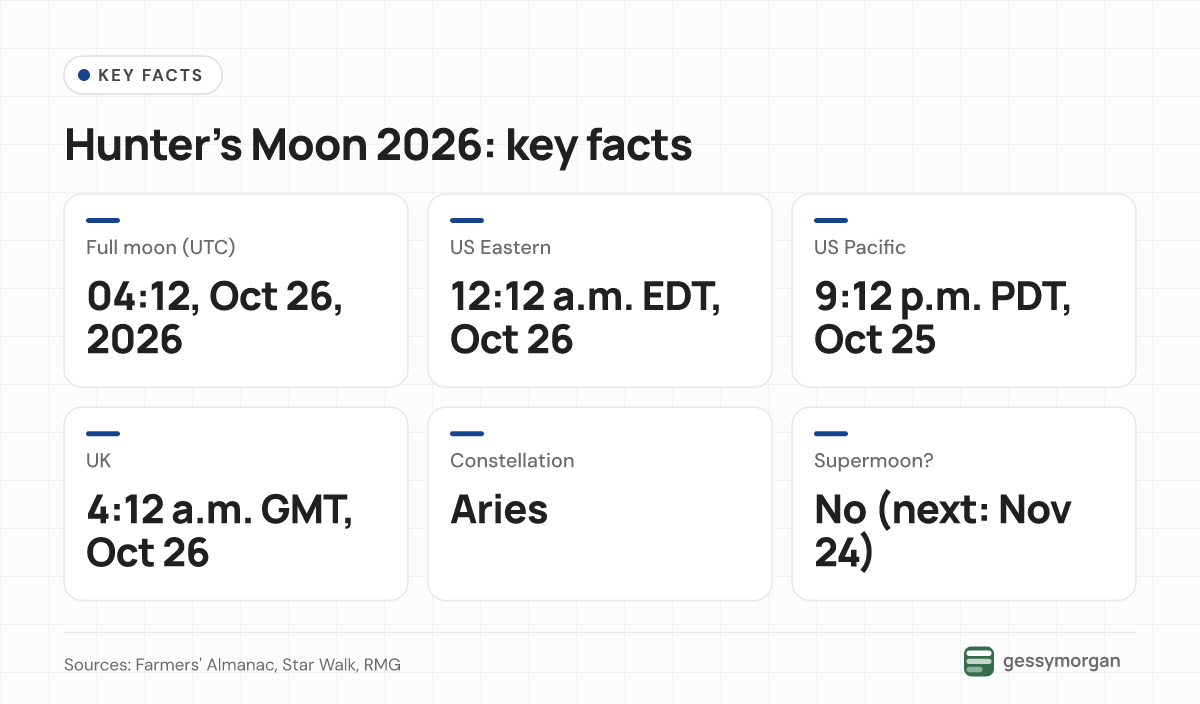
- The Hunter's Moon was full at 04:12 UTC on October 26, 2026: 12:12 a.m. EDT, or 9:12 p.m. PDT on October 25.
- It is the first full moon after September's Harvest Moon, named for the autumn hunting season; it is not a supermoon.
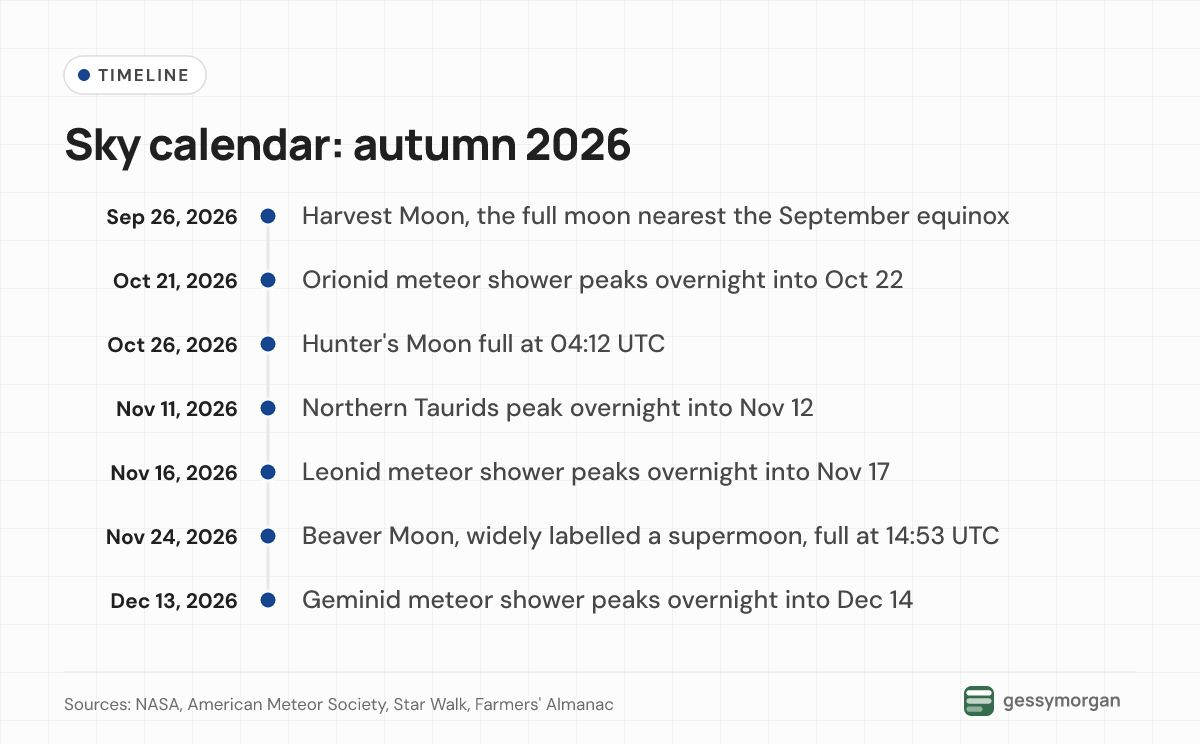
- Next up: the Leonids peak on the night of November 16-17, and the Beaver Moon, widely labelled a supermoon, is full at 14:53 UTC on November 24.
The October 2026 full moon, the Hunter's Moon, reached its full phase at 04:12 UTC on Monday, October 26, 2026. That was 12:12 a.m. EDT on October 26 on the US East Coast, but still Sunday evening, October 25, further west: 11:12 p.m. CDT, 10:12 p.m. MDT and 9:12 p.m. PDT. The moon will still look full tonight, October 26, so there is another chance to see it rise.
Below are the exact times by time zone, why it is called the Hunter's Moon, what happened with the Orionid meteor shower, and the sky events coming next, including November's Beaver supermoon and the Leonids. Times are as of October 26, 2026.
When was the October 2026 full moon?
Full moon happens at a single instant worldwide; only the local clock time changes. The Farmers' Almanac and Star Walk both give 04:12 UTC on October 26, and Royal Museums Greenwich lists 4.12am UK time.
- UTC and London (GMT): 04:12, Monday, October 26
- New York (EDT): 12:12 a.m., Monday, October 26
- Chicago (CDT): 11:12 p.m., Sunday, October 25
- Denver (MDT): 10:12 p.m., Sunday, October 25
- Los Angeles (PDT): 9:12 p.m., Sunday, October 25
- Paris 05:12, Tokyo 13:12 and Sydney 15:12, all on October 26 (Star Walk)
A few sources differ. The Old Farmer's Almanac gives 12:11 a.m. EDT, and its full moon table shows 5:11 GMT, which does not match the four-hour gap between EDT and GMT. BBC Sky at Night Magazine's table lists 03:12 UTC on October 25, which conflicts with the other sources cited here. NASA's October skywatching guide lists the full moon on October 25, which is the local date in US time zones west of Eastern.
The moon sits in the constellation Aries, near the stars Hamal and Sheratan, according to Star Walk, which also notes that the moon, Saturn and the star Algenib form a near-equilateral triangle on October 25 and 26. Star Walk confirms it is not a supermoon, and despite the Blood Moon nickname, the Farmers' Almanac notes there is no total lunar eclipse on October 26.
Why is it called the Hunter's Moon?
The Hunter's Moon is the first full moon after the Harvest Moon, which is the full moon closest to the September equinox. In 2026 the Harvest Moon fell on September 26, according to the Farmers' Almanac and Astronomy.com.
The name comes from the autumn hunting season. With crops gathered, fields were bare, game animals had fattened, and bright evening moonlight let hunters track them later into the night, the Old Farmer's Almanac explains. The Farmers' Almanac says English settlers brought the name to North America.
There is also an astronomical reason the moon seems to linger. Moonrise usually comes about 50 minutes later each night, but around this time of year at mid-northern latitudes the delay shrinks to roughly 25 to 30 minutes, EarthSky explains. That gives several evenings in a row with a bright moon soon after sunset.
Other names for October's full moon include the Travel Moon, Dying Grass Moon, Falling Leaves Moon and Sanguine or Blood Moon, a nod to a reddish rising moon seen through autumn haze rather than an eclipse. The Hunter's Moon occasionally falls in November; Star Walk says the next time will be in 2028.
The Orionid meteor shower
The Orionids peaked on the night of October 21 to 22, 2026, according to NASA and the American Meteor Society (AMS). The shower stays active until November 7, so occasional Orionids are still possible.
- Source: dust shed by Halley's Comet, which also produces the Eta Aquarids in May.
- Rate: about 10 to 20 meteors an hour under dark skies at the peak, NASA says.
- Speed: about 66 km (41 miles) per second, fast enough to leave glowing trails that can linger.
- Radiant: just north of Betelgeuse, the bright star in Orion.
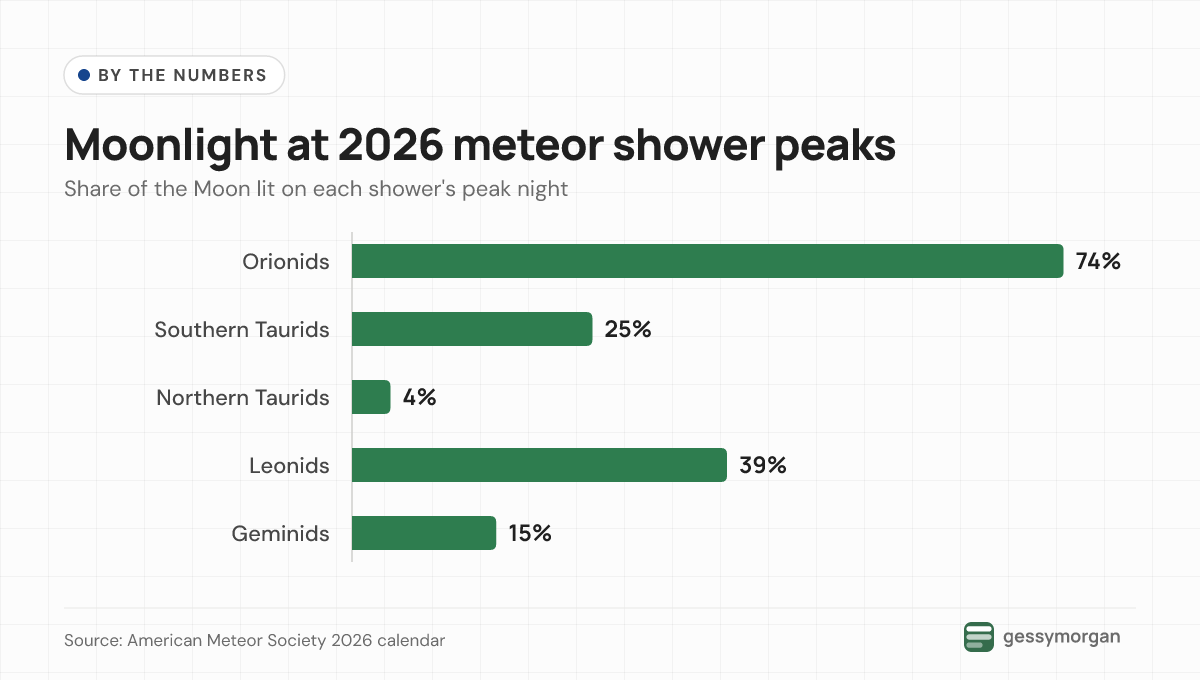
This year's peak competed with moonlight. The AMS lists the moon as 74% lit, a waxing gibbous, on the peak night, and NASA advised watching in the hours before dawn after moonset. With a bright moon up for most of the night this week, late Orionids will be harder to spot.
Moonlight will be less of a problem for the next showers. The AMS puts the moon at 25% lit for the Southern Taurids peak, 4% for the Northern Taurids, 39% for the Leonids and 15% for the Geminids.
Next sky events: Taurids, Leonids and a Beaver supermoon
Taurid fireballs (early to mid-November)
The AMS lists the Southern Taurids peaking on the night of November 4 to 5 and the Northern Taurids on November 11 to 12. Rates are low, but the Taurids are known for fireballs, and the Northern Taurid peak comes with only a thin crescent moon.
Leonid meteor shower (November 16 to 17)
NASA lists the Leonids as active from November 6 to 30, 2026, peaking on the night of November 16 to 17. Typical rates are modest, with NASA's fast facts giving fewer than three meteors an hour, but Leonids are among the fastest meteors, at roughly 70 km (44 miles) per second, and are known for bright fireballs.
Their parent is Comet 55P/Tempel-Tuttle, which orbits the Sun every 33 years. The Leonids have produced meteor storms of 1,000 or more an hour, most famously in 1966, and most recently in 2002, NASA notes. The AMS does not expect Earth to meet a dense stream of debris this year.
Beaver Moon supermoon (November 24)
The next full moon is the Beaver Moon, at 14:53 UTC on Tuesday, November 24, 2026. That is 9:53 a.m. EST, according to Star Walk and the Farmers' Almanac calendar, and 2.53pm GMT in the UK, per RMG. Astronomy.com lists 9:54 a.m. By then the US will be on standard time; our guide to daylight saving time ending in 2026 explains the clock change.
Star Walk, Astronomy.com, Sky at Night and both almanacs call November's full moon a supermoon. RMG's 2026 calendar does not label it one, which reflects differing definitions: Astronomy.com and the Farmers' Almanac use a full moon within about 90% of the moon's closest approach to Earth, while RMG describes a full moon falling very near that closest point. The Farmers' Almanac says supermoons look about 7% larger and 15% brighter than an average full moon.
December's Cold Moon follows at 8:28 p.m. EST on December 23, which is 01:28 UTC on December 24, and several of the same sources also label it a supermoon. The Geminids peak on the night of December 13 to 14 under a slim crescent moon and, unlike most showers, are active well before midnight, the AMS says.
How to watch the moon and meteors
- Catch moonrise: look east around sunset. Near the horizon the moon can look golden or orange and appear larger, an effect known as the moon illusion, Star Walk notes.
- Find a dark site: for meteors, get away from city and street lights and allow up to 30 minutes for your eyes to adjust, NASA advises.
- Look away from the radiant: NASA suggests aiming your gaze 45 to 90 degrees from it, where meteors appear longer.
- Bonus sight: the moon passes near the Pleiades star cluster on the evenings of October 27 and 28, according to NASA.
Weather and local horizon matter more than the exact minute of full moon, so check a local forecast before heading out.
Frequently asked questions
What time was the full moon in October 2026?
The Hunter's Moon was full at 04:12 UTC on Monday, October 26, 2026. That was 12:12 a.m. EDT on October 26, and 11:12 p.m. CDT, 10:12 p.m. MDT or 9:12 p.m. PDT on Sunday, October 25. In the UK it was 4.12am GMT.
Why is it called the Hunter's Moon?
It is the first full moon after the Harvest Moon. Traditionally, bare post-harvest fields and bright evening moonlight made it easier to hunt and stock up on meat before winter, according to the Old Farmer's Almanac and the Farmers' Almanac.
Is the October 2026 full moon a supermoon?
No. Star Walk and other sources say the October 2026 full moon is not a supermoon. November's Beaver Moon on November 24 is widely labelled a supermoon, although Royal Museums Greenwich does not mark it as one.
When is the next full moon after October 2026?
The Beaver Moon is full at 14:53 UTC on Tuesday, November 24, 2026, which is 9:53 a.m. EST and 2.53pm GMT. December's Cold Moon follows on December 23 (EST), or December 24 in UTC.
When do the Leonids peak in 2026?
NASA and the American Meteor Society list the Leonid peak on the night of November 16 to 17, 2026, with activity from November 6 to 30. Expect only a few meteors an hour, best after midnight away from city lights.
Sources
- When is the next full Moon? Full Moon Calendar 2026, Royal Museums Greenwich
- Hunter's Moon 2026: October Full Moon Date, Folklore, and Viewing Guide, Farmers' Almanac
- Full Moon Calendar 2026: Next Full Moon, Dates, Times & Names, Farmers' Almanac
- October Full Moon 2026 (Hunter's Moon): Date, Time & Meaning, Star Walk
- Full Hunter's Moon, October 2026: Date, Meaning, and Folklore, The Old Farmer's Almanac
- When Is the Next Full Moon? Full Moon Dates for 2026, The Old Farmer's Almanac
- 2026 Full Moon calendar: When to see the Full Moon and phases, Astronomy
- Next full Moon 2026 calendar dates and rise times, BBC Sky at Night Magazine
- Orionids, NASA Science
- Leonids, NASA Science
- What's Up: October 2026 Skywatching Tips from NASA, NASA Science
- Meteor Shower Calendar, American Meteor Society
- Full Hunter's Moon (explainer), EarthSky
How we wrote this
GessyMorgan explainers are built from public reporting and official sources. This post draws on the 13 sources listed above, each linked where we use it. It was drafted with AI assistance and checked against those sources before publishing. We did not test products, attend events or interview anyone for this article. Facts are current as of October 26, 2026, and we update the post when they change.